
Restoration Services — Water, Mold, Sewage, Fire & Storm Damage Across Utah County
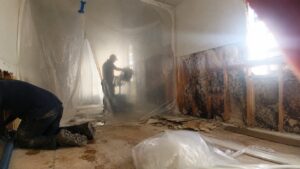
Restoration is not one service. It is a tree of related services with different protocols, different equipment, different timelines, and different paperwork. A toilet overflow in a Salem basement and a kitchen grease fire in a Canyon Creek townhome both fall under “restoration,” but the work has almost nothing in common — different IICRC standards, different categorization, different PPE, different reconstruction sequence. This page is the map of what we do, organized by category, with links to the deeper service pages where each protocol lives.
Every service below is performed under Utah Contractor License #961339-4102 and IICRC Firm Certification #923321-2371, with documentation that adjusters from Allstate, State Farm, Farmers, USAA, Cincinnati Insurance, Liberty Mutual, and Nationwide accept on first submission.
Water Damage Restoration
The largest category by call volume. Most Utah County water losses fall here — burst supply lines, washing machine hose failures, dishwasher discharges, water heater ruptures, ice-maker line splits, refrigerator slow leaks, sump pump failures during spring runoff. Work is performed under ANSI/IICRC S500 protocols.
Water Damage Restoration overview →
Sub-Services
- Emergency Services — 24/7 dispatch, under-60-minute arrival across Spanish Fork, Springville, Salem, Payson, Mapleton
- Water Extraction — truck-mounted extractors at 150 in/Hg vacuum, portable units for upper-floor and tight-access losses
- Structural Drying — air movers, LGR dehumidifiers, psychrometric monitoring to ANSI/IICRC S500 dry standard
- Dehumidification — Phoenix 200 MAX class equipment (130 PPD AHAM), grain-depression targeting
- Moisture Detection — FLIR thermal imaging, Protimeter penetrating and pinless meters, capacitance scanning
- Basement Flooding — finished and unfinished basements, sump pump failure recovery, foundation seepage
- Restoration Process — full project workflow from emergency call through final clearance
- Insurance Claims — Xactimate-formatted estimates, direct carrier billing, AOB workflow
- Commercial Services — office buildings, retail, restaurants, multi-tenant properties
Damage Categorization (Categories 1, 2, 3 and Classes 1–4)
Before any drying begins, we categorize the loss. The category determines what gets saved and what gets demolished; the class determines drying timeline and equipment load. Both come from ANSI/IICRC S500.
- Clean Water (Category 1) — supply line breaks, broken sink fixtures, ice maker lines; minimal contamination, materials usually salvageable
- Grey Water (Category 2) — washing machine and dishwasher discharge, water from above traveling through building materials, aquarium leaks; porous materials at risk
- Black Water (Category 3) — sewage, toilet overflow with feces, ground floodwater, river backflow; full PPE protocol, demolition of porous materials, EPA List N disinfection
- Hidden Leaks — slow leaks discovered during thermal scanning, supply line pinholes, slab leaks, wall cavity migration
- Crawlspace — saturated rim joists, vapor barrier failures, sustained 65%+ humidity colonization
- Attic Leaks — ice-dam intrusion, frost-melt staining, bath-fan misvented into attic cavity, roof penetration failures
Mold Remediation
Performed under ANSI/IICRC S520 protocols. Containment, mechanical removal, EPA-registered antimicrobial application, and third-party post-remediation verification (PRV) air sampling. Most Utah County mold work follows a water event or sustained crawlspace humidity issue — the moisture source has to be identified and corrected before remediation, or the colony returns within months.
- Mold Removal — 6-mil polyethylene containment, negative-pressure differential, HEPA filtration (99.97% capture at 0.3 microns)
- Mold Prevention — humidity control, vapor barrier installation, moisture source elimination, ventilation correction
- Black Mold — Stachybotrys chartarum identification and remediation, distinct from Cladosporium and Aspergillus protocols
- Mold Inspection & Testing — visual inspection, air sampling, tape lifts, AIHA-accredited lab analysis
Sewage Cleanup
Category 3 black water by definition. Sewage requires demolition of porous materials inside the contamination zone, full PPE (Tyvek, half-face respirator with P100 filters, nitrile gloves), EPA List N disinfection of non-porous surfaces, and air-quality verification before reconstruction begins. Per IICRC S500 §12.2.4 and §12.2.5, porous materials touched by Category 3 water cannot be reliably decontaminated and are removed as biohazard waste.
- Toilet Overflow Cleanup — bathroom-contained overflow, supply line failure, wax ring leak, flange failure
- Sewage Backup Cleanup — mainline blockage, lateral line failure, septic backflow, basement floor drain backup
Fire & Smoke Damage Restoration
Performed under ANSI/IICRC S700 protocols. Fire damage restoration is layered — the flames are the headline; the smoke is the long story. Soot is acidic, especially from kitchen protein fires, and damages metal, marble, and finished wood within 7–14 days. Smoke moves wherever air moved during and after the fire, which means closets, drawer interiors, and HVAC ductwork carry contamination that DIY cleaning misses.
- Fire Damage Restoration — full-scope structural and contents recovery after residential and commercial fires
- Smoke Damage Cleanup — HEPA-vacuum smoke residue removal, wall and ceiling washing, HVAC decontamination
- Soot Removal — dry-sponge soot lifts, web-style and ribbon-style soot characterization, surface-specific cleaning
- Odor Removal Services — Odorox MDU/RX 3500 hydroxyl generators (occupied-space safe), ozone for unoccupied structures only
- Fire Damage Board-Up — emergency boarding of windows, doors, and roof openings to secure the structure
Specialty Cleaning Services
Services that don’t fit cleanly into the water/mold/fire trees but are part of every comprehensive restoration project.
- Air Scrubbing & HEPA Filtration — Predator 750 class scrubbers, 99.97% capture at 0.3 microns, used during mold remediation, sewage cleanup, fire restoration, and dusty demolition
- Biohazard Cleanup — blood, bodily fluids, unattended death, hoarding cleanup, crime and trauma scenes; OSHA bloodborne pathogen protocol
- Contents Cleaning & Pack-Out — climate-controlled off-site cleaning at our Spanish Fork facility, electronics decontamination, document drying, soft-goods restoration
Reconstruction & Repair
After the dry-out, after the remediation, after the soot is gone — the structure still has to be put back together. Most national restoration franchises subcontract this phase, which means a second crew, a second invoice, and a second project timeline for the homeowner. We hold Utah Contractor License #961339-4102 specifically so reconstruction can happen under the same project file with the same crew that handled the dry-out.
- Drywall Repair (Water Damage) — partial-board replacement, full-room replacement, texture matching, paint matching
- Flooring Removal & Replacement — carpet and pad, hardwood plank, LVP, tile, sheet vinyl; subfloor inspection and replacement when needed
- Reconstruction & Repairs — finish carpentry, cabinet refinishing, baseboard and trim, paint, fixture replacement
Storm & Weather-Driven Damage
Spanish Fork Canyon funnels storm systems into Utah Valley, and the freeze-thaw cycle on east-facing eaves creates ice dams that drive water back under shingle courses. Spring runoff from Wasatch snowmelt peaks the Spanish Fork River and Hobble Creek at 200–400 cfs in May–June, which raises basement seepage risk in Palmyra, river bottoms, and lower Centennial. Summer monsoon cells off the Wasatch produce wind-driven rain and occasional 1.5-inch hail.
- Storm Damage — wind-driven rain intrusion, hail-impact ceiling damage, ice-dam roof leaks, wind-damaged roof and siding
Commercial, Multi-Family & Industrial
Different stakes, same standards. A water loss in an apartment stack, an office building, a restaurant, or a warehouse slab can shut down operations and trigger landlord-tenant timelines we have to meet. Multi-family work specifically requires coordinated tenant communication, certificate-of-insurance compliance for the property management company, and project scheduling that doesn’t disrupt non-affected units.
- Commercial Flood Cleanup — office buildings, retail, restaurants, after-hours sprinkler discharge, large-loss extraction
- Industrial Water Damage — warehouse slabs, manufacturing facilities, roof drain failures, process water spills
- Multi-Family Water Damage Restoration — apartment stacks, condo associations, HOA-managed properties, tenant relocation coordination
How to Decide Which Service You Need
Most callers don’t know which category of restoration their problem falls under, and that’s fine — it’s our job to figure that out. A short decision tree:
- Standing or recently-pooled water from any source: Water Damage Restoration. We categorize on arrival.
- Visible mold, musty smell, prior water event with no follow-up: Mold Remediation, starting with inspection and testing.
- Sewage smell, toilet overflow, basement floor drain backup, septic problem: Sewage Cleanup. Don’t ventilate or run the HVAC until we’re on-site.
- Recent fire of any size, lingering smoke odor, soot anywhere visible: Fire & Smoke Damage Restoration.
- Storm event, ice dam, wind-driven rain, hail, roof leak after weather: Storm Damage. Time-sensitive — secondary mold growth begins within 48–72 hours of intrusion.
- Apartment building, office, restaurant, warehouse, multi-tenant property: Commercial / Multi-Family. Timelines and scheduling differ from residential.
- You’re not sure: Call (385) 247-9387 for a free phone consultation. The call lasts 5–10 minutes and either resolves the question or schedules a free site visit.
Frequently Asked Questions About Our Services
- What’s the difference between water damage restoration and mold remediation, and do I need both?
- Water damage restoration handles the active water event — extraction, drying, dehumidification, returning the structure to dry standard under ANSI/IICRC S500. Mold remediation handles microbial colonization that has already occurred, performed under ANSI/IICRC S520 with containment, HEPA filtration, and post-remediation verification. If we arrive within 24–48 hours of a water event and the affected area dries to S500 standard within 96 hours, mold remediation is rarely needed because microbial colonization typically requires 48+ hours of sustained moisture. If the water event went undiscovered for a week, two weeks, or longer, both services are usually required and we run them sequentially — dry first, then remediate visible growth, then verify with air sampling.
- Why are there so many water damage sub-services? Isn’t it all just “drying out the house”?
- Each sub-service is a distinct skill with distinct equipment. Extraction (removing standing water) is different from structural drying (returning materials to dry standard) is different from dehumidification (removing moisture from the air to support drying) is different from moisture detection (finding hidden moisture before it causes secondary damage) is different from insurance claims documentation (preparing the project file for the carrier). On a typical Class 2 finished basement loss, all five sub-services happen on the same project — but each requires specific equipment (truck-mounted extractor, LGR dehumidifier, low-profile air mover, FLIR thermal camera, Xactimate) and specific protocol decisions. The sub-service pages explain what’s involved at each step.
- Can 4Sure handle the entire project from emergency response through final reconstruction, or do I need to hire a separate contractor?
- One project, one crew, one file. Utah Contractor License #961339-4102 specifically allows us to perform reconstruction work — drywall replacement, flooring installation, paint, finish carpentry, cabinet refinishing — under the same project authorization that covers the dry-out. Most national restoration franchises don’t carry a full contractor license and have to subcontract the rebuild, which means a second crew, a second timeline, and a second invoice. We see no benefit to that arrangement for the homeowner. The exception is specialty work (plumbing, electrical, HVAC, roofing, hazardous materials abatement) — those require licensed specialty contractors, and we coordinate with them directly without making it the homeowner’s project to manage.
- What’s the difference between hydroxyl generators and ozone for odor removal?
- Hydroxyl generators (Odorox MDU/RX 3500 class) produce hydroxyl radicals that neutralize odor molecules at the molecular level — safe to operate in occupied spaces with people, pets, and plants. Ozone is a more aggressive oxidizer, faster-acting in some cases, but unsafe in occupied spaces because ozone exposure damages lung tissue, kills indoor plants, and degrades rubber and certain plastics. Per IICRC S700 guidance, we use hydroxyl as the default for residential smoke restoration and reserve ozone for unoccupied structures with full evacuation protocols. If a restoration company tells you to leave the house for 72 hours so they can run ozone, that’s not necessarily wrong — but ask why hydroxyl wasn’t an option first.
- Why is “biohazard cleanup” listed alongside water damage and mold? They seem unrelated.
- They share the same regulatory framework — OSHA bloodborne pathogen training, EPA-registered disinfection products, full PPE protocols, and biohazard waste disposal — and most restoration companies that handle Category 3 sewage are also equipped to handle blood, bodily fluids, hoarding cleanup, and trauma scenes. The skills overlap: containment, decontamination, deodorization, and structural restoration after the contamination zone is cleared. The category is listed separately because it’s typically not insurance-covered the same way (homeowners insurance varies on biohazard coverage; some claims are paid through victim assistance programs or commercial general liability rather than property insurance), and the privacy and discretion required for trauma cleanup specifically is different from a standard water loss.
Contact 4Sure Mold Removal — Spanish Fork Emergency Response
Operating from 1330 S 1400 E in Spanish Fork, our team responds 24/7 across Utah County and typically arrives on-site within 60 minutes of dispatch in Spanish Fork, Springville, Salem, Payson, and Mapleton. Whether the call is about a slow leak in Centennial, an ice-dam intrusion in Maple Mountain Estates, a sewer backup in Salem, or a kitchen fire in Canyon Creek, the same documented protocols and the same equipment leave our Spanish Fork shop on every call.
- Emergency Line (24/7): (385) 247-9387
- Address: 1330 S 1400 E, Spanish Fork, UT 84660
- Email: info@4suremoldremoval.xyz
- Owner: Sean Jacques
- Utah Contractor License: #961339-4102
- IICRC Firm Certification: #923321-2371
Office Hours
- Emergency Service: 24 hours a day, 7 days a week
- Office Staff: Monday – Friday, 8:00 AM – 5:00 PM
- Closed: Weekends and State/Federal Holidays (emergency line always active)