
Structural Drying in Spanish Fork & Utah County — ANSI/IICRC S500 Psychrometric Drying with Daily Documentation
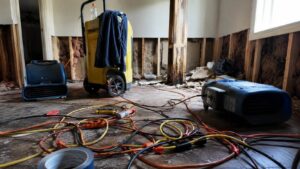
Structural drying is the part of water damage restoration that happens after the water is gone but before the walls are back together. It’s also the part most homeowners don’t recognize as a distinct skill — they assume “drying” is what happens automatically once the extraction trucks leave. It isn’t. Structural drying is a measured, calculated process that runs on the psychrometric chart, not on intuition. Done right, a Class 2 finished basement in Spanish Oaks returns to ANSI/IICRC S500 dry standard in 72–96 hours and reconstruction starts on day five. Done wrong — equipment undersized, placement guessed, monitoring skipped — the same project runs nine days, develops hidden mold inside drywall cavities, and returns the homeowner to a remediation invoice in three months that triples the original cost.
4Sure Mold Removal performs structural drying under ANSI/IICRC S500 protocols across Spanish Fork, Springville, Salem, Payson, and Mapleton, with daily moisture logging that adjusters from Allstate, State Farm, Farmers, USAA, Cincinnati Insurance, Liberty Mutual, and Nationwide read directly from the project file. Every job is performed under Utah Contractor License #961339-4102 and IICRC Firm Certification #923321-2371.
What Structural Drying Actually Is
Structural drying is the controlled removal of moisture from building materials — drywall, framing lumber, subfloor sheathing, hardwood plank, plaster, masonry — back to the equilibrium moisture content (EMC) those materials would naturally hold in your home’s normal indoor climate. The target is not “no moisture”; the target is the moisture content of an unaffected reference area in the same building. Hardwood plank in a Spanish Oaks home built in 2010 lives at roughly 7–9% moisture content during winter and 9–11% during summer. Drywall in the same home reads roughly 0.5–1.5% moisture content year-round. The reference area for that home — say, the living room hardwood and the upstairs hallway drywall — establishes what “dry” actually means for the affected zones.
Drying happens through three simultaneous processes that the technician balances against each other:
- Evaporation — water moves from substrate surface into the air, accelerated by air movement across the surface
- Vapor pressure differential — water vapor migrates from areas of higher concentration (wet substrates) to areas of lower concentration (drier ambient air), driven by the differential between substrate vapor pressure and air vapor pressure
- Dehumidification — the LGR or desiccant dehumidifier removes water vapor from the air, lowering ambient grain-per-pound (GPP) and steepening the vapor pressure differential, which accelerates evaporation
Air movers without dehumidifiers just move humid air around — the substrates dry slightly, the air saturates, and equilibrium is reached without further drying. Dehumidifiers without air movers create a slow drying gradient at the substrate surface but don’t reach moisture trapped deeper in the material. Both run together, sized to the chamber’s cubic footage and material load, with the technician adjusting placement daily based on which substrates are drying fastest and which are lagging.
The Psychrometric Chart — How Drying Decisions Get Made
Every structural drying project runs on a printed psychrometric chart that tracks four variables across the project timeline: ambient temperature (T), relative humidity (RH), grain depression (the difference in grains per pound of moisture between affected zone and outdoor reference), and substrate moisture content (%MC for wood, %WME for non-wood materials read in wood-equivalent units).
The chart determines:
- Whether drying is progressing on schedule — daily readings should show steady decline; flat or rising readings signal an equipment, placement, or hidden-moisture problem
- When to add or remove equipment — too much air movement on day three accelerates drying but wastes equipment cost; too little prolongs the project
- Whether the affected zone has reached dry standard — every substrate moisture reading must match the documented unaffected reference area before equipment is pulled
- Whether ambient conditions support continued drying — if outdoor humidity rises significantly (Utah County summer thunderstorms, spring runoff humidity), the dehumidifier load increases and the timeline may shift
The chart is left visibly on-site at the homeowner’s request, so you can watch the daily progress without waiting for the email. Most homeowners who pay attention to the psychrometric chart understand the project better than the adjusters who eventually review the file.
Equipment Used on Every Spanish Fork Drying Project
LGR Dehumidifiers — The Workhorse of Structural Drying
Low-Grain Refrigerant (LGR) dehumidifiers are the standard for residential structural drying. They use a refrigerated coil to condense water vapor out of the air, and they’re rated by AHAM (Association of Home Appliance Manufacturers) at 80°F and 60% relative humidity — the AHAM rating tells you how many pints per day (PPD) of moisture the unit can remove under those reference conditions. Real-world performance varies with actual chamber temperature and humidity, but AHAM gives a comparable benchmark across equipment.
- Phoenix 200 MAX class: 130 PPD AHAM rating, our standard residential workhorse, sized for chambers up to roughly 1,500 cubic feet of saturation
- Phoenix 270 HTX class: 180+ PPD AHAM, deployed for commercial work and large residential losses where standard 200 MAX capacity is exceeded
- Desiccant dehumidifiers: Used in cold-temperature drying scenarios (below ~50°F) where LGR efficiency drops sharply, or in low-humidity scenarios where condensation isn’t viable. Less common in residential work but essential for some Class 4 specialty losses
Air Movers — Surface Evaporation Acceleration
Air movers create directional airflow across substrate surfaces, accelerating evaporation by replacing the saturated boundary layer of air immediately above the wet surface with drier ambient air. Two types deployed depending on application:
- Centrifugal air movers: 2,800 CFM capacity, low-profile, used for wall-floor junctures, baseboard areas, and most general drying applications
- Axial air movers: Higher CFM, broader airflow pattern, used for open-floor commercial spaces and large saturated areas where directional flow is less critical than total air exchange
HEPA Air Scrubbers — Air Quality During Demolition
When demolition is part of the drying process (saturated drywall removal, carpet pad disposal, baseboard removal), HEPA air scrubbers run during the work to capture airborne particulates and prevent migration into non-affected zones. Predator 750 class scrubbers capture at 99.97% efficiency at 0.3 microns — fine enough to catch fungal spores, drywall dust, and most airborne biocontaminants.
Hidden-Cavity and Specialty Drying
- Injectidry positive-pressure manifolds: Used for wall cavity, ceiling cavity, and crawlspace drying where air movers can’t reach. Small access holes are drilled, pressurized warm dry air is injected directly into the cavity, and moisture is driven out through the seams and gaps
- Mat-Force tented drying panels: Used for hardwood plank drying in place — a low-profile manifold system that pulls warm dry air through the plank from above without removing the flooring
- Indirect-fire heaters: Used for cold-weather drying when the chamber needs supplemental heat to reach the temperature range where LGR dehumidifiers operate efficiently
How a Drying Chamber Gets Designed
“Setting the chamber” looks simple from the outside — equipment shows up, equipment gets placed, equipment runs. The actual decisions behind the placement involve:
Cubic Footage Calculation
Length × width × ceiling height of the affected zone gives the chamber volume. Equipment load is calculated against this volume, plus a multiplier for the type of saturation (Class 1, 2, 3, or 4). A 600 sq ft Class 2 finished basement with 8-foot ceilings is 4,800 cubic feet — typically requiring 2–3 LGR dehumidifiers and 5–7 air movers, plus an air scrubber if demolition is involved.
Containment Decisions
If the affected zone connects to non-affected living space, poly sheeting and zipper doors isolate the chamber so dehumidifiers don’t pull moisture from adjoining unaffected rooms (which would slow drying and stress the dehumidifiers unnecessarily). For ceiling losses where moisture has migrated upward into the attic or downward into the basement, both zones are included in the chamber even if they aren’t visibly damaged.
Air Mover Placement
Centrifugal air movers are angled at the wall-floor juncture (the joint between baseboard and floor where most absorption happens) at roughly 15–30 degree angles, aimed to create a circulating pattern that doesn’t blow directly at the dehumidifier inlet. Improper placement is the most common drying mistake — air movers blowing directly at the dehumidifier short-circuit the airflow and reduce drying efficiency by 20–40%.
Dehumidifier Placement
LGR dehumidifiers go in the lowest, coolest part of the chamber when possible (cold air holds less moisture, and the dehumidifier’s cooling effect is more efficient at lower starting temperatures). Discharge airflow from the dehumidifier is directed away from saturated substrates and toward the air-mover circulation path. In multi-story or multi-zone losses, dehumidifiers may be staged in series or in parallel depending on grain-per-pound load.
Daily Monitoring — The Six Days That Determine Success
Day 0 (Chamber Set)
Baseline ambient T/RH logged on the psychrometric chart. Initial moisture content readings taken on every affected substrate at minimum three points per material per room. Reference readings taken on unaffected substrates of the same material in the same building. Equipment runtime hours recorded. Daily moisture goals printed and left on-site.
Day 1
Ambient T/RH re-logged, grain depression calculated. Substrate moisture readings at the same points. Comparison to day 0 — substrates that dried significantly are flagged for potential equipment reduction; substrates that didn’t move are flagged for additional air movement, additional dehumidification, or further investigation (may indicate hidden moisture not addressed during chamber set).
Days 2–4
Same daily cycle. By day 3, most Class 2 substrates show meaningful progress toward dry standard; substrates that aren’t progressing are investigated for hidden moisture (capillary migration into framing not initially captured in the moisture map, slow leak source not fully identified, equipment placement issue). Drywall behind baseboards and wall cavities are checked with penetrating meters at this stage.
Day 5–6 (Class 2 Typical Closeout)
Dry standard reached on every substrate. Final moisture readings logged, photographed, and matched against the documented reference area. Drying Goal Met certification signed by the on-site lead. Equipment runtime hours captured for billing accuracy. Project file finalized for submission to the insurance carrier.
What “Dry Standard” Actually Means
“Dry standard” under ANSI/IICRC S500 §12.2.7 means moisture content readings on every affected substrate match the moisture content of a documented unaffected reference area in the same building, using the same measurement methodology. It is a numeric standard, not a visual or tactile one. Specifically:
- Drywall: Typically below 16% WME (wood moisture equivalent), within 2–4 percentage points of the unaffected reference
- Framing lumber and subfloor sheathing: Typically below 16% MC, within 2–4 percentage points of unaffected reference
- Hardwood plank: Typically 7–11% MC depending on season and indoor climate, must match unaffected plank in the same home
- Plaster and masonry: Measured with capacitance and resistance scanning rather than penetrating meters; must match unaffected reference areas of the same material
- Concrete slab: Calcium chloride test or relative humidity probe insertion, with a target typically below 5 lbs/1000 sq ft/24 hr emission rate or below 75% RH at the slab depth
“Dry to the touch” is not a standard. “It looks dry” is not a standard. Surface readings often miss substrate moisture by 15–30 percentage points — a wall can read dry on the surface and still be saturated inside the cavity. We measure with penetrating and pinless meters at multiple points and we don’t pull equipment until every reading hits target.
Why Class 4 Specialty Drying Takes Longer Than Most Restoration Companies Will Tell You
Class 4 specialty losses involve materials that resist normal drying — hardwood plank, plaster on wood lath, dense concrete, thick masonry, engineered I-joists with deep cavities. These materials don’t absorb water quickly, but they don’t release it quickly either. Aggressive air movement and high-capacity dehumidification on Class 4 materials can actually cause damage (cracking on plaster, splitting on hardwood) without significantly accelerating drying.
Class 4 drying uses:
- Lower temperature, slower vapor pressure differentials
- Mat-Force tented panels for hardwood plank to drive moisture out gradually
- Injectidry manifolds for wall cavities and behind plaster
- Desiccant dehumidification for low-temperature scenarios
- Daily monitoring extended to 10–14 days, sometimes longer
Restoration companies that don’t carry Applied Structural Drying (ASD) certification or Class 4 specialty equipment often skip Class 4 work or rush it, which damages the materials and produces inadequate drying. We perform Class 4 drying when the loss requires it; we don’t shortcut the timeline to match a typical Class 2 expectation.
Frequently Asked Questions About Structural Drying
- Can I just put fans and a household dehumidifier in the room myself instead of hiring a structural drying crew?
- For a small Class 1 loss where you caught the water within the first hour and dried it within 24 hours, yes — a box fan and a residential dehumidifier may be sufficient. For anything larger or anything that sat longer, no. Residential dehumidifiers (the kind sold at Home Depot for $200–$400) are rated at roughly 30–50 PPD AHAM, which is a fraction of the 130 PPD an LGR dehumidifier delivers. Household fans don’t generate the directional airflow needed to penetrate substrate boundary layers. And there’s no monitoring — you don’t know whether the wall behind the baseboard is actually drying. Most “I tried to dry it myself” losses we get called back on are now mold remediation projects because the surface dried but the substrate didn’t, and microbial colonization started inside the wall cavity within 48 hours.
- Why are dehumidifiers and air movers running for 4–6 days when the area looked dry on day 2?
- Because surfaces dry before substrates dry. Drywall paper can read 4% moisture content (visibly and tactilely dry) while the gypsum core behind it reads 22% moisture content. Framing lumber under saturated subfloor can hold moisture for days after the subfloor surface looks dry. Pulling equipment based on what’s visible is the single most common cause of secondary mold growth in restoration work — the moisture continues migrating after the equipment leaves, and within two weeks, hidden colonization begins. We measure with penetrating meters at multiple points and we don’t pull equipment until every reading matches the documented unaffected reference area.
- Will the dehumidifiers and air movers spike my electric bill, and does insurance cover the additional electricity cost?
- Yes and yes — partially. A typical Class 2 chamber with 3 LGR dehumidifiers and 6 air movers running 24/7 for 4 days uses roughly 280–360 kWh, which at Utah’s average electricity rate of $0.11/kWh is $31–$40 of incremental electricity. Most homeowners insurance policies include a “loss of use” clause that covers reasonable additional living expenses caused by a covered loss, including incremental utility costs documented during mitigation. We provide an equipment runtime log with daily kWh estimates so you can submit the cost to your carrier with the rest of the claim. Carriers routinely pay this expense when documented; they routinely deny it when not documented.
- What’s the difference between LGR dehumidifiers and the desiccant dehumidifiers I see on some commercial sites?
- LGR (low-grain refrigerant) dehumidifiers use a refrigerated coil to condense water vapor out of the air. They work most efficiently in the 65–90°F range with at least 40% relative humidity — the typical conditions of a residential drying chamber. Desiccant dehumidifiers use a chemical desiccant (silica gel, lithium chloride) that adsorbs water vapor regardless of temperature, then releases it through a heat-driven regeneration cycle. Desiccants are essential for cold-weather drying (below 50°F where LGR efficiency drops sharply), low-humidity drying (where condensation isn’t viable), and Class 4 specialty drying where slow, controlled vapor pressure differentials are needed. Most residential losses use LGR because the chamber temperature is normal indoor range; commercial and industrial work more often uses desiccants depending on the building’s HVAC capacity and the season.
- If structural drying is so technical, why doesn’t every restoration company use psychrometric charts and daily moisture logs?
- Many don’t. The IICRC Applied Structural Drying (ASD) certification — the credential that teaches psychrometric chart use, grain depression calculation, and daily monitoring discipline — is held by a fraction of the technicians working in residential restoration nationally. Companies that don’t hold ASD certification often default to “drop equipment, come back when the room looks dry, hope nothing grows back” — which works most of the time on small Class 1 losses and fails predictably on Class 2 and larger. The carriers know which firms produce IICRC-grade documentation and which produce “trust us, it’s dry” estimates, and the difference shows up in claim approval timelines. Our firm certification (#923321-2371) is the company-level credential; our technicians hold the ASD individual certification on top of that.
Contact 4Sure Mold Removal — Spanish Fork Emergency Response
Operating from 1330 S 1400 E in Spanish Fork, our team responds 24/7 across Utah County and typically arrives on-site within 60 minutes of dispatch in Spanish Fork, Springville, Salem, Payson, and Mapleton. For drying-specific questions — whether your situation needs a structural drying chamber, what timeline to expect, what equipment your loss requires — call the office line for a free phone consultation.
- Emergency Line (24/7): (385) 247-9387
- Address: 1330 S 1400 E, Spanish Fork, UT 84660
- Email: info@4suremoldremoval.xyz
- Owner: Sean Jacques
- Utah Contractor License: #961339-4102
- IICRC Firm Certification: #923321-2371
Office Hours
- Emergency Service: 24 hours a day, 7 days a week
- Office Staff: Monday – Friday, 8:00 AM – 5:00 PM
- Closed: Weekends and State/Federal Holidays (emergency line always active)