
Mold Inspection & Testing in Spanish Fork & Utah County — AIHA-Accredited Lab Analysis, Air Sampling, and Documented Findings
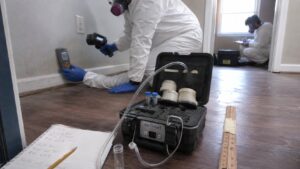
Mold inspection without lab analysis is a guess. The visible patch behind a Spanish Oaks shower wall might be Stachybotrys chartarum requiring full containment, Cladosporium requiring household cleaning, or Aspergillus niger requiring something in between — and the difference is invisible to the naked eye. Inspection that produces a written report without sample analysis can describe what was seen, but it can’t tell you what species are present, what spore counts indicate about indoor air quality, or whether the affected area meets clearance standards after remediation. The actual answer requires samples, and samples require an AIHA-accredited laboratory to interpret correctly.
4Sure Mold Removal performs mold inspection and testing across Spanish Fork, Springville, Salem, Payson, and Mapleton, with sample analysis routed through third-party AIHA-accredited laboratories. Every inspection produces a written report with thermal images, moisture readings, sample collection documentation, lab analysis results, and prioritized recommendations. Work is performed under Utah Contractor License #961339-4102 and IICRC Firm Certification #923321-2371.
What an Inspection Actually Includes
Phase 1: Property Walk-Through and Visual Assessment
The technician walks every room with a FLIR E8-XT thermal camera and a Protimeter Hygromaster 2, identifies visible growth, traces moisture-source clues, and documents the property’s overall condition. Specific items captured during the walk-through:
- Visible mold growth locations with photographs and measurements
- Thermal anomalies indicating possible hidden moisture or growth
- Capacitance moisture readings on suspect surfaces
- Substrate identification (drywall, wood, tile, carpet, etc.) — relevant to lab analysis interpretation
- Ventilation conditions in bathrooms, attics, and crawlspaces
- HVAC system condition at intake and supply registers
- Foundation drainage indicators (basement walls, slab condition, sump operation)
- Roof penetration condition visible from interior (skylight perimeters, chimney flashing penetrations, plumbing vent stack penetrations)
Phase 2: Sample Collection
Samples go to AIHA-accredited laboratories for species identification and quantification. The standard sample types we use:
- Air sample (spore-trap cassette): A pump pulls a measured volume of air through a cassette (Air-O-Cell or BioCassette) over a defined time period (typically 5 minutes at 15 liters per minute). Spores collected on the cassette are analyzed under microscopy by lab technicians, providing a per-cubic-meter spore count by genus. Used to assess indoor air quality and compare against outdoor reference. Standard for both initial assessment and post-remediation verification.
- Tape lift (surface sample): Clear adhesive tape is pressed against visible growth, lifted, and sealed in a sample container. Lab analysis identifies the genus and sometimes the species of the colony. Used to confirm species identity on visible growth, particularly when the protocol decision depends on whether the colony is Stachybotrys or one of the visually similar species.
- Swab sample: A sterile swab collects material from porous surfaces or areas inaccessible to tape. Used for similar identification purposes as tape lifts; particularly useful for HVAC component sampling and dusty-substrate sampling.
- Bulk sample: A piece of the suspect material itself is collected and submitted. Used for definitive species identification when surface sampling produces ambiguous results, or for materials destined for replacement where the colony depth needs characterization.
- Outdoor reference sample: Air sample taken outside the property using the same equipment and time interval. Establishes the baseline spore count for the local environment, which is the comparison standard for indoor samples.
Sample chain-of-custody documentation accompanies every submission — collection date and time, technician name, sample location within the property, environmental conditions at collection (temperature, humidity), and laboratory submission tracking. Defensible documentation matters because lab results without chain-of-custody can be challenged in insurance disputes or real estate transactions.
Phase 3: Lab Analysis Through AIHA-Accredited Facility
Samples ship to a partner AIHA-accredited laboratory for analysis. Standard turnaround is 3–5 business days; rush turnaround (24–48 hours) is available for an additional fee. Analysis includes:
- Spore identification by genus, sometimes by species when morphological characteristics permit
- Spore counts per cubic meter for air samples
- Comparative analysis against outdoor reference for air samples
- Surface-sample characterization for tape lifts, swabs, and bulk samples
- Quality control documentation per AIHA accreditation requirements
The lab does not know which contractor submitted the sample or what the sample location was — they receive only the chain-of-custody form and the sample. This blind analysis is what makes the results defensible against conflict-of-interest concerns.
Phase 4: Written Report Delivery
Within 1–2 business days of receiving lab results, the inspection report is delivered. The report contains:
- Property identification (address, inspection date, technician)
- Property walk-through findings with annotated floor plan
- Thermal images with timestamps and notes on any thermal anomalies
- Moisture content readings at every measured location
- Photographs of visible growth, suspect areas, and overall conditions
- Sample collection locations and chain-of-custody documentation
- Laboratory analysis results with full lab report attached
- Outdoor reference comparison for air samples
- Findings summary identifying confirmed species, estimated affected area, and severity assessment
- Moisture source analysis connecting growth to suspected water sources
- Recommendations with prioritization (immediate remediation, deferred concern, no action required)
- Cost estimate in Xactimate format if remediation is recommended
The report is designed to satisfy multiple audiences: the homeowner trying to understand what was found, the insurance adjuster reviewing a claim, the real estate inspector reviewing during a transaction, and the future remediation contractor (if not us) who needs technical detail to scope the work.
The Five Reasons Homeowners Request Mold Inspection
1. Visible Growth With Unknown Species
The homeowner sees something — staining on bathroom drywall, fuzzy growth in a basement corner, dark patches in an attic — and wants to know what it is and what it means. The inspection identifies the species, characterizes the moisture source, and recommends action. Most common request type, particularly from homeowners who’ve researched online and seen the “black mold” coverage that creates concern about Stachybotrys.
2. Symptoms Without Visible Growth
Persistent musty smell, unexplained respiratory complaints among occupants, recurring sinusitis or asthma exacerbations, “something feels off” indoor air quality. No visible mold but symptoms suggest hidden growth. The inspection uses thermal imaging and air sampling to find what’s not visible. This category produces the most “we found something” outcomes for previously-undiscovered colonies.
3. Pre-Purchase or Pre-Listing Real Estate Inspection
Buyers requesting inspection before closing on properties with prior moisture history. Sellers requesting inspection before listing properties to disclose any findings or document a clean condition. The report becomes part of the real estate transaction, satisfying both buyer due-diligence and seller-disclosure obligations. Real estate agents in Utah County increasingly recommend inspection on properties with any documented prior water event.
4. Insurance Dispute Documentation
An active insurance claim is in dispute — coverage scope disagreement, cause-of-loss categorization, or adjuster scope reduction. Independent inspection from an IICRC-certified firm with AIHA-accredited lab analysis carries weight in the dispute resolution process. The inspection produces documented technical evidence that supports the homeowner’s position when warranted.
5. Post-Remediation Verification (PRV)
Remediation work has been completed and clearance testing is required to confirm the affected area is back to Condition 1. PRV is the verification step in the IICRC S520 protocol. We perform PRV on our own remediation projects through the same AIHA-accredited labs we use for inspection; for remediation done by other contractors, we perform third-party PRV to provide independent verification.
What Lab Results Actually Mean
Reading lab reports correctly requires understanding what spore counts indicate. Some context homeowners find useful:
Air Sample Interpretation
The lab report typically gives spores per cubic meter (spores/m³) by genus. The interpretation framework most consultants and remediators use:
- Indoor count significantly above outdoor reference (3–5× or more): Indicates an indoor amplification source — active growth somewhere in the building producing spores into indoor air
- Indoor count similar to outdoor reference: No indoor amplification source; indoor spore load is from normal outdoor air infiltration
- Indoor count below outdoor reference: Building filtration is working effectively; spore load is below typical for the local environment
- Specific genera elevated indoors but absent outdoors: Strong indication of indoor source, particularly for Stachybotrys, Chaetomium, or Memnoniella which are uncommon in outdoor air in non-agricultural environments
Counts vary by season, weather, geography, and sampling conditions; there are no fixed “safe” or “unsafe” thresholds in the way the term gets used in popular media. The comparison against outdoor reference is what matters, not the absolute count.
Tape Lift and Swab Interpretation
Surface samples answer the question “what is this growth?” rather than “how much is in the air?” The lab report identifies the genus and quantifies relative concentration (typically expressed as “few,” “moderate,” or “abundant” spores or hyphal fragments). For protocol decisions, identification matters more than quantification — confirming the colony is Stachybotrys rather than Cladosporium changes containment scope regardless of whether the surface sample reads “moderate” or “abundant.”
What Independent Inspection Means and Why It Matters
Inspection by the same company that would perform the remediation creates an obvious conflict of interest — the contractor has financial incentive to find problems that justify remediation work. The cleanest practice is independent inspection (a separate firm performing inspection, with the homeowner choosing remediation contractor based on the findings). Several Utah County firms perform inspection-only work without remediation services; a referral list is available on request.
For situations where independent inspection isn’t practical — small projects, urgent timelines, properties where the homeowner has already chosen 4Sure for remediation — we manage the conflict through transparency and lab independence. Specifically:
- The lab is third-party. AIHA-accredited laboratory analysis is independent of our financial interest in the project; the lab doesn’t know we’re the submitter when analyzing samples.
- Sample collection is documented. Chain-of-custody and sample location documentation prevents post-hoc adjustment of findings.
- Findings are reported as-found. Reports document what the lab found without editorializing toward a remediation conclusion. If the findings don’t support remediation, the report says so.
- Recommendations are conservative. We recommend remediation only when the findings clearly warrant it. For findings that fall in the “monitor and address moisture source” category, we recommend exactly that — not remediation that isn’t actually necessary.
If you’re considering inspection for an insurance dispute, real estate transaction, or any situation where independence matters specifically, hiring a separate inspection-only firm is the cleaner approach. We will provide remediation services if you choose us based on independent inspection findings, but we recognize the value of separating the two services.
Inspection Pricing and What’s Included
Standard inspection pricing depends on property size and sample count:
- Small inspection (single room, 1–2 samples): $285–$450 typical
- Standard residential inspection (3–5 rooms, 3–6 samples): $450–$850 typical
- Whole-house inspection (full property, 6–12 samples): $850–$1,650 typical
- Commercial inspection: Quoted per project; varies by property size, occupancy type, and access requirements
Pricing includes property walk-through, sample collection, lab analysis fees, written report delivery, and follow-up consultation. The fee is credited toward project cost if remediation work proceeds with us.
For PRV (post-remediation verification) on remediation work performed by other contractors, pricing typically falls in the small or standard inspection range depending on project size and sample count. PRV-only work is welcomed; we don’t require homeowners to use us for both inspection and remediation.
Insurance Coverage for Mold Inspection
Insurance coverage for inspection follows mold-claim coverage patterns:
- Inspection within an active claim: When part of a covered water damage or mold claim, inspection costs are typically covered as part of mitigation scope
- Pre-purchase or pre-listing inspection: Generally not covered by current policy — buyer or seller pays out of pocket
- Inspection for known or suspected hidden growth: Coverage varies. Sometimes covered as part of investigative scope when paired with a pending or recently-closed claim; sometimes excluded
- PRV after covered remediation: Typically covered as part of the remediation claim
For inspections that aren’t insurance-covered, the out-of-pocket cost is usually a fraction of the eventual remediation cost the inspection helps to scope correctly — or, when no remediation is needed, the out-of-pocket cost is the price of not undertaking unnecessary remediation.
Frequently Asked Questions About Mold Inspection & Testing
- Do I really need lab testing, or can I just have someone visually inspect for mold?
- For most situations, yes — you need lab testing. Visual inspection identifies what’s there but can’t reliably distinguish between species that look similar. The protocol decisions depend on species: Stachybotrys requires full containment, Cladosporium often doesn’t; the cost differential is 30–60%. Testing also captures hidden growth that visual inspection misses — air samples reveal indoor spore amplification from sources behind walls, in HVAC systems, or in attic cavities that aren’t visible during walk-through. The exception is small visible patches on non-porous surfaces (tile grout, painted wood, sealed concrete) where the species identification doesn’t change the recommendation (clean it, dry the area, monitor for recurrence). Free phone consultations help determine whether your specific situation needs testing or whether visual assessment is sufficient.
- How long does mold inspection take from first call to final report?
- Typical timeline: scheduling within 1–3 business days of the initial call, on-property walk-through and sample collection in 1–3 hours depending on property size, lab turnaround in 3–5 business days for standard analysis (24–48 hours for rush turnaround at additional cost), report delivery in 1–2 business days after lab results return. Total from first call to final report: typically 7–10 business days for standard turnaround, 3–5 days for rush. For urgent situations (real estate transactions with deadlines, active health concerns, time-sensitive insurance dispute), rush turnaround compresses the timeline meaningfully.
- What’s the difference between using 4Sure for inspection and hiring an independent industrial hygienist?
- An industrial hygienist (CIH or other certification) is a separate professional category — typically with a science or engineering degree plus specialized indoor air quality training, certified through the American Board of Industrial Hygiene. CIHs perform inspection-only work, don’t have remediation conflict of interest, and are appropriate for situations involving complex health concerns, legal disputes, or commercial environments with regulatory oversight. Their reports carry significant weight in litigation and regulatory contexts. Their pricing is usually higher ($800–$3,500+ for residential inspection) than restoration-firm inspection. For straightforward residential inspection where the question is “what’s here and should we remediate,” restoration-firm inspection (with AIHA-accredited lab analysis) is usually sufficient and more cost-effective. For complex situations where independence and credentials matter most, a CIH is the right call. We can provide CIH referrals on request.
- Will the inspection actually find hidden mold behind walls or in attics, or only confirm what I can already see?
- It depends on the inspection scope and the specific situation. Visible growth gets sampled directly via tape lift or swab. Hidden growth detection relies on indirect indicators: thermal anomalies (cold spots from evaporation or warm spots from active microbial activity), elevated air spore counts compared to outdoor reference (suggesting indoor amplification source), capacitance moisture readings indicating wet substrates that support growth. For high-suspicion situations where indirect indicators suggest hidden growth but no visible confirmation exists, borescope inspection through small drilled access holes provides direct visual confirmation. Borescope inspection adds incremental cost ($150–$400 per access location) but produces definitive findings rather than inferred ones. We discuss whether borescope investigation is warranted during the initial walk-through; not every project needs it, but for “musty smell with no visible growth” situations, it’s often the only way to find what’s actually there.
- If the inspection finds something and I don’t want to remediate immediately, what are my options?
- You have several. First, the report’s recommendations are prioritized — immediate remediation, deferred concern, or monitoring — and findings in the deferred or monitoring categories don’t require immediate action. Second, source correction (addressing the underlying moisture problem without remediation) sometimes prevents further colonization without active remediation; the colony stops growing once the moisture source is eliminated, though existing growth doesn’t disappear on its own. Third, partial remediation (handling the most concerning findings while monitoring less-concerning ones) is a legitimate intermediate option for budget-constrained situations. Fourth, deferring remediation entirely and monitoring with follow-up testing every 6–12 months is appropriate for very small isolated findings without health concerns or amplification indicators. We document whatever decision the homeowner makes and provide the report with that decision noted, so future questions about why action wasn’t taken have a clear answer.
Contact 4Sure Mold Removal — Spanish Fork Mold Inspection & Testing
Operating from 1330 S 1400 E in Spanish Fork, our team responds 24/7 across Utah County and typically arrives on-site within 60 minutes of dispatch in Spanish Fork, Springville, Salem, Payson, and Mapleton. For non-emergency mold inspection — pre-purchase or pre-listing assessments, post-remediation verification, suspected hidden growth investigation, insurance dispute documentation — call the office line during business hours to schedule.
- Emergency Line (24/7): (385) 247-9387
- Address: 1330 S 1400 E, Spanish Fork, UT 84660
- Email: info@4suremoldremoval.xyz
- Owner: Sean Jacques
- Utah Contractor License: #961339-4102
- IICRC Firm Certification: #923321-2371
Office Hours
- Emergency Service: 24 hours a day, 7 days a week
- Office Staff: Monday – Friday, 8:00 AM – 5:00 PM
- Closed: Weekends and State/Federal Holidays (emergency line always active)