
Basement Flooding in Spanish Fork & Utah County — Spring
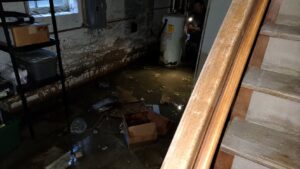
Runoff, Sump Failures, and Foundation Seepage
Basement flooding is a problem with a Utah County signature. The Wasatch funnels snowmelt into Spanish Fork Canyon every spring, peaks the Spanish Fork River and Hobble Creek at 200–400 cfs in May–June, and saturates the alluvial soils across the valley floor for weeks. Homes in Palmyra, river bottoms, lower Centennial, and parts of Salem and Payson sit on shallow water tables during peak runoff — when sump pumps fail, foundation cracks open under hydrostatic pressure, or sewer mainlines back up under the load, the basement is where it shows up first. The same is true in winter when freeze-thaw cycling on east-facing eaves drives ice-dam meltwater down through walls into the basement, and in summer when sudden monsoon cells dump 1–2 inches of rain on saturated ground in 30 minutes.
4Sure Mold Removal performs basement flooding cleanup, structural drying, and reconstruction under ANSI/IICRC S500 protocols across Spanish Fork, Springville, Salem, Payson, and Mapleton. Every project is documented with psychrometric logs, moisture maps, thermal images, and a Drying Goal Met certification under Utah Contractor License #961339-4102 and IICRC Firm Certification #923321-2371.
The Six Most Common Basement Flooding Causes in Utah County
1. Sump Pump Failure During Spring Runoff
The single most common basement flooding cause in Utah County. Sump pumps run continuously during peak Wasatch snowmelt — typically late April through early June — and components that worked fine through dry summer and fall conditions fail under sustained load. Common failure modes:
- Float switch failure: Mechanical float gets stuck in the down position, pump never activates while the basin fills
- Motor burnout: Pump runs continuously for days under heavy groundwater load and the motor fails from overheating
- Discharge line freeze (early spring): Pump activates but the frozen exterior discharge line blocks flow; water recirculates into the basin and overflows
- Power failure during storm: Battery backup runs out within 4–8 hours; if power doesn’t restore in time, the basin overflows
- Aging pump (over 7–10 years old): Pump capacity degrades over time as the impeller wears; the unit may “work” but can’t keep up with peak inflow
Sump failures often happen overnight when nobody’s watching the basin — homeowners wake up to standing water that rose silently while they slept.
2. Foundation Wall Seepage Under Hydrostatic Pressure
When groundwater rises against foundation walls, hydrostatic pressure forces water through any available path: hairline cracks in poured concrete, joints between concrete blocks, gaps around basement windows, the cold joint between footing and foundation wall, and around penetrations for plumbing and electrical service. Common in homes built in the 1970s–80s where waterproofing membranes have aged out, and in newer homes where landscaping changes (added planters, regraded soil, downspout extensions removed) have redirected surface water toward the foundation.
3. Sewer Line Backup During Heavy Rain
Spanish Fork, Springville, Salem, Payson, and Mapleton all have municipal sewer infrastructure that can become overloaded during heavy rain events. When the main line capacity is exceeded, the backup pressure pushes sewage water back up through floor drains, basement toilets, basement laundry standpipes, and basement bathroom fixtures. This is Category 3 black water — handled under our Sewage Cleanup protocols with full PPE, demolition of porous materials, and EPA List N disinfection.
4. Burst Supply Line in Basement Mechanical Areas
Water heaters, washing machines, water softeners, and whole-house humidifiers are typically installed in basement mechanical rooms or laundry areas. Supply line failures at these appliances can release significant water before discovery — particularly when the failure happens during a multi-day vacation. A water heater rupture can release 40–60 gallons in the failure event itself plus continuing supply pressure flow until the main is shut off.
5. Window Well Overflow During Heavy Storm
Basement window wells are designed to drain through perforated pipe to a sub-grade dispersal field, but the drain often clogs with leaf debris, sediment, or vegetation roots. During a heavy storm — particularly summer monsoon cells — the window well fills faster than it can drain, water rises above the basement window sill, and the window is forced open or breaks under pressure. Water flows directly into the basement at flooding rates.
6. External Storm Surge and Flash Flooding
Less common but more catastrophic. Spanish Fork Canyon weather systems occasionally produce flash flooding events in the lower valley — Hobble Creek and Spanish Fork River exceeding banks, debris flow off canyon-adjacent slopes, or stormwater overwhelmed culverts. These events typically affect homes near drainage paths and can flood basements with several feet of contaminated water in under an hour.
Why Basement Flooding Is Different From Other Water Losses
Basement losses share characteristics that other water damage doesn’t. Understanding these characteristics is what determines whether a basement flooding response succeeds or extends into mold remediation territory:
Water Travels Down — and Stays Down
Basements are below grade, which means standing water cannot drain by gravity to a lower zone. Once water enters the basement, it sits until extracted. Compare this to a kitchen flood, where water that escapes the affected room often flows toward floor drains, baseboards leading to other rooms, or stairs leading to a lower level. Basement water has nowhere to go until equipment removes it.
Material Saturation Patterns Are Different
Basement walls are typically poured concrete, concrete block, or stone — non-porous materials that don’t absorb significant water but can transmit moisture vapor through capillary migration in the surrounding soil. Basement floors are typically concrete slab. Most of the saturated material is what’s been finished over the structural surfaces: drywall framed against perimeter walls, carpet over concrete slab, finished baseboards, drop ceiling tile, and the contents of the space. The drying problem is concentrated in finished materials with concrete behind/below them, not in framing assemblies the way upstairs floods are.
Air Quality Concerns Are Elevated
Basements have limited natural ventilation. When water sits, the resulting humidity can climb above 80% in hours, which accelerates microbial growth on any porous material. Sustained high humidity also concentrates basement-specific contaminants — radon, mold spores from any prior moisture history, off-gassing from saturated carpet and pad. Air quality management with HEPA scrubbers becomes part of the mitigation, not just an option.
Source-of-Loss Identification Is Often Multi-Factor
A kitchen flood usually has one cause — a specific failed component. A basement flood often has two or three contributing factors: the sump pump failed, the storm dropped 1.5 inches of rain, the discharge line was partially frozen, and the foundation crack that’s been seeping for years finally accelerated. The technician arriving on a basement flooding call has to identify each contributing factor before the source-of-loss documentation is complete — otherwise the same flood happens again next spring.
What Spring Runoff Looks Like in Utah County
Spring runoff is predictable enough to plan for. The Wasatch snowpack accumulates from November through April; melt accelerates as daytime temperatures rise above freezing for sustained periods, typically beginning late March in lower elevations and extending through June in higher elevations. Spanish Fork River and Hobble Creek peak flow timing varies by year but most often falls in the May 15 – June 15 window.
During peak runoff:
- Groundwater tables rise across the valley floor, with shallowest tables in Palmyra, river bottoms, and lower Centennial near the creek and river drainages
- Sump pumps run continuously for weeks, exposing every component to sustained load
- Hydrostatic pressure increases against foundation walls, finding any weakness in waterproofing
- Sewer mainlines run near capacity, raising the risk of backup events during simultaneous heavy rain
- Drainage infrastructure (culverts, storm drains, French drain systems) operates at peak load and reveals any maintenance neglect
For homeowners in the highest-risk areas, we offer pre-runoff inspection visits in March or early April — sump pump testing, foundation crack inspection, drainage assessment, and battery backup verification. The visit typically takes 60–90 minutes and costs $185–$350. Comparing that to a $15,000 finished basement flood remediation is the kind of math most homeowners do correctly when they think about it.
The Basement Flooding Response Protocol
Hour 0–1: Source Identification and Power Safety
The first concern when arriving at a flooded basement is electrical safety — basement standing water near outlets, water heater connections, washer/dryer hookups, and breaker panels creates a serious shock hazard. The technician confirms electrical power is cut to affected zones (or works with the homeowner to identify which breakers serve the basement) before entering standing water. The water source is then identified — sump failure, foundation crack, sewer backup, supply line, window well, or external surge.
Hour 1–3: Bulk Water Removal
For losses with several inches of standing water, submersible pumps run continuously to remove bulk water faster than truck-mount vacuum extraction can manage. Once water depth drops below 1–2 inches, truck-mount extraction takes over, working systematically across the basement floor. Carpet and pad get extracted with weighted wands; if the loss is Category 3 (sewer backup) or the water has sat over 48 hours, demolition replaces extraction on porous materials.
Hour 3–5: Demolition Decisions and Containment
Saturated drywall (typically wet from floor up to the height the water reached) is flood-cut at 2 feet above the high-water mark and removed. Saturated insulation behind that drywall is removed and disposed. Carpet pad is always replaced regardless of water category. For Category 3 losses, all porous materials within the contamination zone are removed under IICRC S500 §12.2.4 protocols. Basement contents are inventoried, photographed, and sorted into “salvageable” and “documented for replacement” categories.
Hour 5+: Drying Chamber Set
The drying chamber design accounts for basement-specific conditions: high cubic footage with relatively low ceiling height, concrete slab and walls behind the affected materials, limited natural ventilation, and the often-finished living space considerations. Equipment typically includes 3–5 LGR dehumidifiers (Phoenix 200 MAX class), 8–14 air movers, 2 HEPA scrubbers, and indirect-fire heat if the basement temperature drops below 50°F during the drying period. Daily monitoring runs 5–9 days for typical Class 2/3 basement losses.
Reconstruction After Basement Flooding
Once dry standard is reached, reconstruction follows under Utah Contractor License #961339-4102. Typical scope:
- Drywall replacement — flood-cut sections rebuilt with new drywall, taped, mudded, textured to match, painted
- Insulation replacement — new fiberglass or rigid foam in affected wall cavities
- Baseboard replacement — new MDF or solid-wood baseboards as specified
- Carpet pad replacement (always) and carpet replacement (when carpet save isn’t viable)
- Cabinet base replacement for any saturated cabinetry in basement kitchens, bars, or laundry rooms
- HVAC condensate line repair if the basement contains the air handler and the condensate line was involved in the loss
- Sump pump replacement or upgrade when the loss was caused by sump failure (subcontracted to licensed plumber when needed)
- Foundation crack repair when seepage was the cause (subcontracted to specialty foundation contractor)
For most insured basement losses, reconstruction is covered under the same claim as mitigation, with the homeowner paying only the deductible. Reconstruction typically runs 5–14 days depending on scope after dry standard is reached.
Frequently Asked Questions About Basement Flooding
- Is basement flooding from spring runoff covered by my homeowner’s insurance?
- It depends on the source. Sump pump failure that allows groundwater to enter is sometimes covered under a “water backup” or “sump pump failure” rider, which is typically optional and not included in baseline policies. Foundation seepage from groundwater rising against the wall is generally not covered (most carriers exclude it as a maintenance issue). External flash flooding from storm surge is excluded from most homeowner’s policies and requires federal NFIP flood insurance. Sewer backup during a rain event is covered when you have a sewer backup rider, and not covered when you don’t. The single most useful thing a Utah County homeowner in a flood-prone area can do is read the declaration page of their policy before spring runoff arrives — most exclusions are visible plainly in the policy and surprises come from finding out about them after the loss. We help homeowners interpret their declaration page when claim coverage is uncertain; if the situation is ambiguous, we work with the carrier through the appeal process before invoicing.
- Why does my basement keep flooding every spring even though I’ve had it cleaned up before?
- Because the underlying source hasn’t been corrected. Recurring spring flooding usually means one of three things: the sump pump system is undersized or failing predictably under sustained load (replace pump, add battery backup, install a high-water alarm), the foundation has cracks or waterproofing failure that hydrostatic pressure exploits annually (foundation crack repair, exterior waterproofing membrane, French drain installation), or surface drainage directs water toward the foundation (regrading, downspout extensions, French drain at problem locations). The cleanup phase is the visible work; the source correction is what prevents the next flood. We document source-of-loss findings in every project file specifically so homeowners can address the underlying cause — not just clean up the symptoms.
- How fast does mold start growing in a flooded basement, and how do I know if it’s already started?
- Microbial colonization on saturated porous materials begins within 48 hours under typical basement conditions (60–80% relative humidity, 65–75°F temperatures). Visible growth typically appears at 5–14 days. The early-warning signs are usually smell-based — a musty, earthy odor distinct from the smell of wet building materials — followed by visible discoloration on drywall surfaces, baseboards, and carpet pad if it wasn’t removed. Hidden colonization behind drywall or under carpet can be harder to detect; thermal imaging and air sampling are the reliable diagnostic tools. If a basement was wet for more than 48 hours and wasn’t fully dried by an IICRC-certified team, mold remediation under our mold protocols is usually required even if no visible growth is apparent yet.
- How long does basement flooding cleanup actually take in Spanish Fork?
- For a typical 600–1,000 sq ft Class 2 finished basement with prompt response: 4–6 days for mitigation (extraction, demolition, drying to S500 standard), then 5–14 days for reconstruction depending on scope. Total from first call to keys back is typically 10–20 days. Class 3 losses with multi-room saturation, Category 3 contamination, or extensive demolition can run 14–30 days for the mitigation phase alone, with reconstruction adding another 10–20 days. The longest projects are basements with delayed response — water that sat for a week, mold colonization that requires remediation under S520 containment, and saturated structural materials that need slow Class 4 specialty drying. Honesty matters here: we tell homeowners on day one what realistic timeline looks like for their specific situation, and we update that estimate at each daily monitoring visit if the project conditions change.
- What’s the difference between sump pump failure flooding and foundation seepage — is the response different?
- The cleanup is the same; the source correction is different. For sump pump failure: extract water, dry the affected area, document the loss, and ensure the sump pump is replaced or repaired (subcontracted to a licensed plumber if the homeowner doesn’t have a service relationship already). The flood doesn’t recur if the pump works and the inflow rate hasn’t changed. For foundation seepage: extract water, dry the affected area, document the loss, and identify the failure points in the foundation wall waterproofing. Source correction here is more complex — usually involving exterior excavation, waterproofing membrane replacement, drain tile installation, and surface drainage redirection. We coordinate with foundation specialty contractors on this side of the work; the cleanup happens regardless, but homeowners with seepage problems usually need a foundation conversation before they can be confident the next storm won’t repeat the flood.
Contact 4Sure Mold Removal — Spanish Fork Emergency Response
Operating from 1330 S 1400 E in Spanish Fork, our team responds 24/7 across Utah County and typically arrives on-site within 60 minutes of dispatch in Spanish Fork, Springville, Salem, Payson, and Mapleton. For active basement flooding, call (385) 247-9387 immediately — every hour of standing water is more substrate absorption and more porous materials past the threshold of what can be saved.
- Emergency Line (24/7): (385) 247-9387
- Address: 1330 S 1400 E, Spanish Fork, UT 84660
- Email: info@4suremoldremoval.xyz
- Owner: Sean Jacques
- Utah Contractor License: #961339-4102
- IICRC Firm Certification: #923321-2371
Office Hours
- Emergency Service: 24 hours a day, 7 days a week
- Office Staff: Monday – Friday, 8:00 AM – 5:00 PM
- Closed: Weekends and State/Federal Holidays (emergency line always active)