
Water Damage Restoration in Spanish Fork & Utah County — ANSI/IICRC S500 Documented Drying
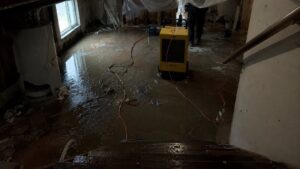
Water damage doesn’t wait. From the moment a supply line bursts at 2 a.m. or a washing machine hose splits during the workday, the loss is measured in hours, not days. Within 24 hours, drywall paper is delaminating. Within 48 hours, microbial colonization begins. Within 72 hours, hardwood plank starts to cup. The first hour after extraction is when the difference between a $4,000 dry-out and a $14,000 mold remediation gets decided — and that decision is made by who answers the phone, how fast they arrive, and whether the chamber gets set the same day or the next.
4Sure Mold Removal performs water damage restoration under ANSI/IICRC S500 protocols across all of Utah County, with under-60-minute dispatch-to-arrival from our Spanish Fork shop at 1330 S 1400 E. Every project is documented with psychrometric logs, moisture maps, thermal images, and a Drying Goal Met certification that adjusters from Allstate, State Farm, Farmers, USAA, Cincinnati Insurance, Liberty Mutual, and Nationwide accept on first submission.
The Utah County Water Damage Catalog
Restoration calls cluster into about a dozen distinct failure patterns by the time they reach our shop. Knowing which pattern you’re calling about helps the technician dispatch the right truck, the right equipment, and the right protocol on the first trip:
- Frozen-pipe ruptures (November–April): PEX or copper supply lines burst when overnight lows drop below 5°F. Most common in homes with PEX runs through unconditioned attic spaces, rim joists, or exterior walls in older Salem, Payson, and downtown Spanish Fork builds.
- Washing machine and dishwasher hose failures: Flexible supply hoses age, crack, and split at the threaded fitting. Usually catastrophic — 5+ gallons per minute discharging until someone notices and shuts the valve.
- Water heater leaks and ruptures: Tank failures from sediment corrosion (most common in homes 12+ years old) or pressure relief valve discharge. Often discovered when the heater is in a finished basement utility room.
- Refrigerator ice-maker line slow leaks: Plastic ¼” supply line splits or pulls loose at the compression fitting. Hardwood plank flooring damage from weeks of capillary migration before discovery.
- Toilet supply line failures: Compression fittings under the tank fail; if the failure happens during a multi-day vacation, hundreds of gallons release before anyone returns.
- Sump pump failures during spring runoff: Pumps fail under sustained load when Wasatch snowmelt peaks Spanish Fork River and Hobble Creek at 200–400 cfs in May–June. Basement seepage in Palmyra, river bottoms, and lower Centennial is most common at this time.
- Ice-dam roof intrusion: Freeze-thaw cycling on east-facing eaves drives meltwater back under shingle courses. Ceiling staining in three or four rooms typical; attic insulation R-value collapses.
- Pinhole leaks in galvanized and polybutylene supply runs: Older homes built 1970s–80s with original galvanized or polybutylene plumbing develop pinhole leaks behind drywall. Often discovered during thermal imaging on a separate call.
- Slab leaks: Supply or drain line failure under the foundation slab. Hot-spot concrete, baseboard moisture, or tile cracking are early signs.
- Sprinkler discharge (commercial): Fire sprinkler heads activate from heat, mechanical damage, or vandalism. Average 25 gallons per minute until shut off; commercial buildings can take on 4,000+ gallons before mitigation.
- Sewage backups: Mainline blockage, lateral failure, or septic backflow. Category 3 black water — handled under our Sewage Cleanup protocols.
- Storm-driven intrusion: Wind-driven rain through soffit vents, hail-impact ceiling damage, or canyon-wind events forcing water through siding seams.
What Happens in the First Four Hours
The four-hour window from the moment we arrive to the moment the drying chamber is set is the most consequential phase of the project. Done correctly, a Class 2 finished basement loss returns to dry standard at 96 hours and reconstruction begins on day five. Done incorrectly — extraction half-finished, drying equipment undersized, no moisture map drawn — the same loss can run nine days, with secondary mold growth requiring separate mold remediation.
Hour 0–1: Walk-Through and Categorization
The on-arrival technician walks the affected area with a FLIR E8-XT thermal camera and a Protimeter Hygromaster 2, identifies the source, traces the migration path, and categorizes the loss under ANSI/IICRC S500. Category 1 (clean water from a sanitary source), Category 2 (grey water with significant contamination), and Category 3 (black water with biohazard contamination) each trigger different protocols. The technician also classifies the loss as Class 1 (minimal absorption), Class 2 (significant absorption into porous materials), Class 3 (saturation of walls, ceilings, and structure), or Class 4 (deeply saturated low-permeability materials like hardwood plank or plaster on lath).
Hour 1–2: Extraction
Standing water comes out first, with truck-mounted extractors pulling at roughly 150 in/Hg vacuum. Carpet and pad get wet-extracted in Class 1 and Class 2 losses; Category 3 losses skip extraction on porous materials and go directly to demolition. Extraction reduces the moisture load by 60–80% before any drying equipment is staged, which dramatically shortens the structural drying window.
Hour 2–3: Demolition (When Required)
For Category 3 losses or for materials clearly past saving (delaminated drywall, saturated insulation, cupped hardwood with ongoing migration), demolition happens before the chamber is set. Removing wet materials before drying begins reduces the moisture load on the dehumidifiers, shortens timeline, and eliminates substrates that would otherwise serve as mold colonization sites during the dry-out.
Hour 3–4: Chamber Set and Baseline
“Setting the chamber” means staging air movers and LGR dehumidifiers in calculated positions, isolating the affected zone from non-affected zones with poly sheeting if needed, logging baseline ambient temperature and relative humidity on the psychrometric chart, calculating the daily grain depression target, and printing the moisture goals. The chamber typically uses Phoenix 200 MAX class dehumidifiers (130 PPD AHAM), 2,800 CFM low-profile air movers, and Predator 750 HEPA scrubbers when air-quality control is needed.
Days 1–6: Structural Drying to ANSI/IICRC S500 Standard
Once the chamber is set, structural drying runs on a daily monitoring cycle. Every 24 hours a technician returns to log moisture content readings (penetrating meter for wood substrates, pinless meter for finished surfaces, capacitance scan for hidden cavities), adjust equipment placement based on which substrates are drying fastest and slowest, capture a thermal-image timestamp, log the day’s psychrometric snapshot (T, RH, GPP), and email the day’s progress report to the homeowner.
“Dry standard” under S500 means moisture content readings on every affected substrate match a documented unaffected reference area in the same building. For drywall, that’s typically below 16% WME (wood moisture equivalent). For framing lumber and subfloor, it’s typically below 16% MC and within 2–4 percentage points of the reference reading. We don’t pull equipment until every reading hits target — “dry to the touch” is not a standard.
Class-Based Timeline Expectations
- Class 1 (small, contained, mostly hard surfaces): 48–72 hours to dry standard. Bathroom tile floors with minor wall absorption, kitchen sheet vinyl with limited substrate involvement.
- Class 2 (significant absorption into porous materials): 72–96 hours. Most finished basement losses in Spanish Oaks, Palmyra, Maple Mountain Estates, Centennial.
- Class 3 (saturated walls, ceilings, and structure): 5–9 days. Multi-room saturation events, ceiling-down losses from upstairs failures.
- Class 4 (deeply saturated low-permeability materials): 10–14 days. Hardwood plank, plaster on lath, dense concrete — moisture must migrate slowly out of the material under controlled vapor pressure.
Specialty Drying Situations
Hardwood Plank Drying
Hardwood that’s been wet for under 48 hours, on a subfloor that’s also drying well, can usually be saved with tented drying using Mat-Force panels — a low-profile manifold system that pulls warm dry air through the plank from above without removing the flooring. Plank that’s been wet longer, has cupped or crowned visibly, or sits over a saturated subfloor with no drying access from below, often has to come up so the substrate can be dried directly. The decision is made on day 2 and day 4 moisture readings, not on what the floor looks like.
Hidden-Cavity Drying
Wall cavities, ceiling cavities, and crawlspaces with limited drying access use Injectidry positive-pressure manifolds — a system that injects warm dry air directly into the cavity through small drilled access holes, pressurizing the cavity to drive moisture out through gaps and seams. Common on losses involving 1948-era plaster ceilings on Center Street, downtown Spanish Fork, or 1970s wall cavities with vapor barrier failures.
Crawlspace and Rim Joist Drying
Crawlspaces with sustained 65%+ relative humidity, saturated rim joists, or vapor barrier failures get a different treatment cycle: dehumidifiers run continuously, mechanical ventilation may be added temporarily, and the vapor barrier is typically replaced as part of the project. Crawlspace water damage often pairs with mold remediation when colonization has already begun.
Documentation: The Project File
Every project produces a documentation packet that goes to your insurance carrier and to you at project closeout. The packet contains:
- Initial loss assessment and source identification
- Moisture map drawn on the property’s floor plan
- Daily psychrometric logs (temperature, RH, grain depression, equipment runtime)
- Daily moisture content readings, point-by-point, with reference area comparisons
- Thermal-image timestamps capturing pre-extraction, mid-dry, and final-dry conditions
- Equipment list with run-time tracking for billing accuracy
- Photos of demolition, drying setup, and final-dry conditions
- Drying Goal Met certification signed by the on-site lead
- Xactimate-formatted estimate with line items matching the work performed
- For projects involving mold or sewage: post-remediation verification (PRV) air sampling lab reports from a third-party AIHA-accredited lab
This packet is what makes a claim move quickly through the carrier’s review. Estimates without IICRC documentation typically take 2–3 weeks for adjuster approval; estimates with the full packet typically clear within 3–5 business days.
Equipment We Stage on Every Truck
- Extraction: Truck-mounted extractors at roughly 150 in/Hg vacuum, portable units for upper floors and tight access
- Dehumidification: Phoenix 200 MAX class LGR dehumidifiers (130 PPD AHAM rating)
- Air movement: Low-profile 2,800 CFM air movers in centrifugal and axial configurations
- HEPA filtration: Predator 750 air scrubbers (99.97% capture at 0.3 microns)
- Hidden-cavity drying: Injectidry positive-pressure manifold systems
- Hardwood drying: Mat-Force tented drying panels
- Moisture detection: FLIR E8-XT thermal cameras, Protimeter Hygromaster 2 (penetrating + pinless), Tramex capacitance scanners
- Containment: 6-mil polyethylene sheeting, zipper doors, negative-air machines
- Water-source repair: SharkBite fittings, PEX crimp tools, basic plumbing repair to stop the source while waiting for licensed plumber dispatch when needed
Service Sub-Pages
Each major component of water damage restoration has its own deeper page with neighborhood-specific examples, equipment specifications, and decision logic:
- Emergency Services — 24/7 dispatch, after-hours response, holiday and weekend coverage
- Water Extraction — truck-mounted and portable extraction protocols
- Structural Drying — air mover placement, LGR dehumidifier sizing, drying chamber design
- Dehumidification — psychrometric chart interpretation, grain depression targeting
- Moisture Detection — thermal imaging, penetrating and pinless meter use, hidden-cavity discovery
- Basement Flooding — finished and unfinished basements, sump pump failure, foundation seepage
- Restoration Process — full project workflow start to finish
- Insurance Claims — Xactimate estimates, AOB workflow, direct carrier billing
- Commercial Services — office buildings, retail, multi-tenant properties
Frequently Asked Questions About Water Damage Restoration
- How quickly do I actually need to call after I find water — does it really matter if I wait until morning?
- It matters significantly. Drywall paper begins delaminating within 24 hours of saturation; microbial colonization on wet substrates begins within 48 hours; hardwood plank cupping is detectable within 72 hours. A loss caught and stabilized in the first six hours typically dries in 72–96 hours and avoids mold remediation entirely. The same loss left for 24 hours often requires partial drywall removal; left for 48–72 hours, it commonly requires full mold remediation under ANSI/IICRC S520, which roughly triples the project cost. Calling at 11 p.m. when you find the leak rather than 7 a.m. when you wake up is the difference between a $4,500 dry-out and a $14,000 dry-out plus remediation.
- What’s the difference between Class 1, 2, 3, and 4 water losses, and how do I know which one I have?
- Class 1 means minimal water absorption, mostly hard surfaces, small affected area — for example, a slow toilet supply leak that wets only the bathroom tile and a small section of vanity baseboard. Class 2 means significant absorption into porous materials with substantial wet substrate area — a typical finished basement flood from a washing machine hose, or a kitchen flood from a dishwasher, where carpet, drywall, and subfloor are all wet. Class 3 means saturation of walls, ceilings, and structural materials across multiple rooms — usually a ceiling-down loss from an upstairs supply line failure. Class 4 means deeply saturated low-permeability materials like hardwood plank, plaster on lath, dense concrete, or thick masonry — these dry slowly because moisture has to migrate out through the material under controlled vapor pressure. Categorization happens on the technician’s first walk-through and determines equipment, timeline, and cost.
- Will my Spanish Fork insurance policy cover the full cost, or will I have surprises?
- Most homeowners policies cover sudden and accidental internal water events — burst pipes, supply line failures, washing machine and dishwasher discharges, water heater ruptures, ice-maker line failures. Most policies do NOT cover gradual leaks ongoing for 14+ days (the carrier’s position is the homeowner had time to detect and fix), groundwater seepage and sewer backup (these usually require separate riders), or flood damage from external sources (which requires a federal NFIP flood policy). Surprises usually come from one of three places: (1) the cause of loss being categorized as gradual rather than sudden, (2) pre-existing damage discovered during work not being covered, or (3) the carrier depreciating reconstruction materials at actual cash value rather than replacement cost. We work through all three with adjusters during the project, but reading your declaration page before the loss is the only real defense against surprises.
- If the affected area looks dry on day three, why are the air movers and dehumidifiers still running?
- Because the surface dries before the substrate dries. Drywall, framing lumber, and subfloor sheathing can read 25–35% moisture content while the surface paint is dry to the touch. Pulling equipment based on visual or hand-feel assessment is the single most common cause of secondary mold growth in restoration work — the moisture in the substrate continues migrating after the equipment leaves, and within two weeks, hidden colonization begins. We don’t pull equipment until penetrating meter readings on every substrate match the documented reference area in the unaffected portion of your home. That’s not stubbornness; it’s the difference between completing the project once and coming back for remediation in three months.
- What’s the difference between water damage restoration and water mitigation, and which one am I paying for?
- “Water mitigation” technically refers to the emergency phase: extraction, initial demolition, drying, and stabilization to prevent further damage. “Water damage restoration” is the broader term that includes mitigation plus reconstruction (drywall replacement, paint, flooring, finish carpentry) to return the property to pre-loss condition. Most insurance estimates separate the two phases — mitigation under one set of Xactimate line items, reconstruction under another, sometimes with the carrier requiring approval between phases. We perform both under Utah Contractor License #961339-4102, but the bill and the timeline reflect the two-phase structure. On a typical Class 2 finished basement project, mitigation runs $3,500–$8,500 and reconstruction runs another $4,500–$9,500 depending on materials.
Contact 4Sure Mold Removal — Spanish Fork Emergency Response
Operating from 1330 S 1400 E in Spanish Fork, our team responds 24/7 across Utah County and typically arrives on-site within 60 minutes of dispatch in Spanish Fork, Springville, Salem, Payson, and Mapleton. Whether the call is about a frozen-pipe rupture in Spanish Oaks, a washing machine failure in Palmyra, an ice-dam intrusion in Maple Mountain Estates, or a sump pump failure during spring runoff in the river bottoms, the same documented protocols and the same equipment leave our Spanish Fork shop on every call.
- Emergency Line (24/7): (385) 247-9387
- Address: 1330 S 1400 E, Spanish Fork, UT 84660
- Email: info@4suremoldremoval.xyz
- Owner: Sean Jacques
- Utah Contractor License: #961339-4102
- IICRC Firm Certification: #923321-2371
Office Hours
- Emergency Service: 24 hours a day, 7 days a week
- Office Staff: Monday – Friday, 8:00 AM – 5:00 PM
- Closed: Weekends and State/Federal Holidays (emergency line always active)