
Toilet Overflow Cleanup in Spanish Fork & Utah County — Bathroom Water Damage From Supply Lines, Wax Rings, and Bowl Overflows
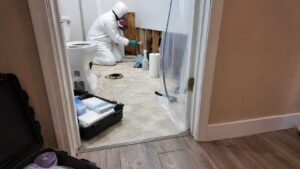
Toilet overflow is the most commonly underestimated water damage event in residential restoration. Homeowners often assume the cleanup is straightforward — mop the floor, run a fan, replace the wax ring — without recognizing that the category of water determines almost every protocol decision that follows. A clean supply-line burst in a Centennial bathroom that’s caught immediately is Category 1 and may be handled with extraction and drying alone. The same volume of water from a clogged bowl that overflowed onto a Spanish Oaks bathroom floor with toilet contents present is Category 3 black water, which means full PPE, demolition of porous materials, EPA List N disinfection, and air-quality verification. The water looks the same on the floor; the protocol is fundamentally different.
4Sure Mold Removal performs toilet overflow cleanup under ANSI/IICRC S500 protocols across Spanish Fork, Springville, Salem, Payson, and Mapleton. Categorization happens on the technician’s first walk-through; protocol follows category, not assumption. Every project is documented under Utah Contractor License #961339-4102 and IICRC Firm Certification #923321-2371.
The Six Most Common Toilet Overflow Causes
1. Wax Ring Failure (Slow Leak Beneath the Toilet)
The wax ring seals the toilet base to the floor flange and prevents sewer gases and waste water from leaking around the connection. Wax rings degrade over 15–25 years and fail gradually — often without visible symptoms until floor damage shows up. Symptoms include floor flexing near the toilet base, water stains on the ceiling below (for upper-floor bathrooms), persistent musty smell that doesn’t respond to cleaning, and visible separation between the toilet and the floor. The water released is Category 3 black water because it carries waste material from every flush; even when the leak is small and slow, the contamination penetrates subfloor sheathing and framing under the toilet.
2. Supply Line Compression Fitting Failure
The flexible supply line connecting the wall shutoff to the toilet tank uses compression fittings or threaded connections that can fail from age, vibration, or improper installation torque. When the supply line ruptures or the compression fitting splits, clean municipal water (Category 1) sprays at full supply pressure — typically 50–80 psi residential — until someone notices and shuts off the wall valve or main. A 30-minute discharge can release 200–400 gallons. The water itself is clean, but the volume often saturates carpet pad in adjacent rooms, drywall along baseboards, and subfloor sheathing through any available migration path.
3. Toilet Tank Failure
The porcelain tank itself develops cracks (from freezing, impact damage, or manufacturing defects) and releases water from inside the tank. The water is Category 1 (clean supply water that filled the tank for flushing). Total volume is typically smaller than supply line failures — the tank holds 1.6 gallons in modern toilets, 3.5–5 gallons in older ones — but the failure is typically gradual and may release water continuously for hours before discovery.
4. Toilet Bowl Overflow From Clog
A clogged toilet — whether from accumulated waste, foreign objects, or downstream blockage — can overflow when flushed. The water that hits the floor is whatever was in the bowl at the time. If the bowl was clean (post-flush state), the overflow is technically Category 2 grey water but often treated as Category 3 due to bowl residue. If the bowl had waste in it (toilet content present), the overflow is unambiguous Category 3 black water. Bowl overflow is the most common Category 3 toilet event we see in residential restoration calls.
5. Floor Flange Failure
The toilet flange is the round fitting that connects the toilet drain to the home’s waste plumbing. Flanges fail through corrosion (cast iron and galvanized steel), cracking (PVC under stress), or settlement-related shifting. When the flange fails, the toilet’s drain connection becomes compromised and either leaks waste water around the connection or allows the toilet to rock, eventually breaking the wax ring seal. Both modes produce Category 3 events.
6. Sewer Line Backup Through the Toilet
When the home’s sewer mainline is blocked downstream — tree root intrusion, mainline grease accumulation, line collapse — wastewater backs up through the home’s lowest fixture, which is often a basement toilet. This is unambiguous Category 3 sewage backup and typically affects multiple fixtures simultaneously. Sewage backup cleanup protocol applies in addition to the bathroom-specific work.
How Categorization Determines the Cleanup Protocol
Category 1 (Clean Water From Supply-Side Failure)
Cleanup follows standard water damage protocol: extraction, drying, monitoring to dry standard, reconstruction where needed. PPE is standard work attire; specialized biohazard equipment isn’t required. Carpet, pad, drywall, and subfloor are typically salvageable with prompt extraction and proper drying. Equipment includes truck-mounted extractors at 150 in/Hg vacuum, LGR dehumidifiers (Phoenix 200 MAX class, 130 PPD AHAM), and air movers staged for 72–96 hour drying. Most Category 1 toilet overflows close out as Class 1 or Class 2 losses depending on affected area.
Category 2 (Grey Water From Bowl Overflow Without Visible Waste)
Cleanup follows enhanced protocol with elevated PPE (nitrile gloves, eye protection) and antimicrobial treatment of all affected surfaces. Carpet pad is replaced even with prompt extraction — Category 2 contamination doesn’t reliably clean from pad. Carpet itself can sometimes be saved with thorough extraction, hot-water cleaning, and antimicrobial treatment. Drywall above the wet line typically remains; saturated drywall at the base may need partial replacement depending on saturation depth and contamination level. Drying timeline runs 72–96 hours similar to Category 1.
Category 3 (Black Water With Toilet Contents or Backup Source)
Cleanup follows full Category 3 protocol: containment with 6-mil polyethylene sheeting, full PPE (Tyvek, half-face P100 respirators, double-gloved nitrile, eye protection), HEPA-filtered wet-vacs for extraction (not standard truck-mount), demolition of porous materials including drywall, insulation, carpet, pad, baseboards, and any saturated cabinet bases. EPA List N disinfection of non-porous surfaces with 5–10 minute contact time. Air-quality verification through third-party AIHA-accredited lab before reconstruction. Full Category 3 protocol detail applies.
Why Bathroom Layout Affects the Cleanup
Bathrooms have a few characteristics that make them different from kitchen and laundry water losses:
Tile Installation Layers
Most modern bathroom floors are tile over cement board over plywood subfloor. Water that gets past the tile and grout migrates through cement board (which doesn’t dry quickly) and into the plywood. Removing tile to access subfloor is invasive and typically destroys the tile installation; alternatives include capacitance scanning to verify subfloor moisture content without demolition, and Mat-Force tented drying through small drilled access points where capacitance readings indicate saturation.
Vanity and Cabinetry
Bathroom vanities are typically MDF or particle board with a thin laminate or wood veneer surface. These materials swell catastrophically when wet — typically within 12–24 hours of saturation — and cannot be dried to functional condition. Vanity replacement is almost always required for any Category 2 or Category 3 toilet overflow that contacts the cabinet base.
Drywall and Baseboards
Bathroom drywall is often standard drywall (sometimes upgraded to greenboard or cement board near the shower, but standard drywall in the toilet area). Saturated drywall is flood-cut at 2 feet above the high-water mark for Category 3 events; for Category 1, the drywall may be salvageable with proper drying if saturation didn’t extend deep into wall cavities.
Adjacent Room Migration
Bathroom floors typically slope toward the floor drain or toward the door threshold. Toilet overflows that exceed bowl capacity often migrate under the door into the hallway, into adjacent bedrooms, or into the room below (for upper-floor bathrooms). Migration patterns are documented during the initial walk-through with FLIR thermal imaging and capacitance scanning.
Upper-Floor Migration to Lower Levels
Upper-floor toilet overflows that aren’t immediately contained migrate through the floor system into ceilings, walls, and floors of the level below. By the time the homeowner discovers ceiling staining downstairs, the overflow has typically been ongoing for hours. Both levels become part of the affected zone, with drying and demolition scope significantly larger than the bathroom alone.
What to Do in the First 15 Minutes of a Toilet Overflow
The first quarter-hour after discovery determines whether a small contained event stays small or escalates into a multi-room project:
- Stop the water source immediately. The wall shutoff valve behind or beside the toilet (typically a chrome or brass quarter-turn valve) closes the supply to the toilet tank. If the wall valve doesn’t function, the main shutoff at the meter or basement-front foundation wall stops all household water.
- Don’t flush again to “clear it.” If the overflow was caused by a clog, a second flush adds water to an already-overflowing bowl. Wait for the clog to clear naturally or call a plumber for snake-out service.
- Protect adjacent rooms from migration. Towels rolled tightly against the bathroom door threshold can buy 5–10 minutes of containment. Move dry contents (rugs, electronics, soft furniture) out of any room the water is flowing toward.
- Assess the water category before deciding to clean. If the water is from supply-line failure with no toilet contents present, it’s Category 1 and DIY surface cleanup may be appropriate. If the water has any visible waste or came from bowl overflow, it’s Category 3 and you should not attempt cleanup yourself — call (385) 247-9387 immediately.
- Document the event with photos. Wide-shot of the bathroom, close-up of the source, photos of any saturated materials, and timestamps for insurance documentation.
- Don’t run fans on Category 3 water. Fans aerosolize sewage particulates and spread contamination through the rest of the house.
How Long Toilet Overflow Cleanup Takes
Project timelines depend heavily on category and affected square footage:
- Category 1, small contained (under 50 sq ft): 24–48 hours total (extraction + brief drying), typically completed in a single day with minimal demolition
- Category 1, larger area (100–300 sq ft including hallway migration): 3–4 days for mitigation and drying; reconstruction depends on whether drywall was affected
- Category 2, bathroom-contained: 4–6 days for mitigation including antimicrobial treatment; carpet pad replacement and minor drywall repair typical
- Category 3, bathroom-contained: 5–7 days for full mitigation including containment, demolition, disinfection, drying, and air-quality verification; reconstruction adds 5–10 days
- Category 3, multi-room with hallway and adjacent-room migration: 8–14 days for mitigation; reconstruction adds another 10–20 days depending on scope
- Upper-floor toilet overflow with ceiling damage downstairs: 10–18 days for mitigation; reconstruction adds 14–25 days due to ceiling rebuild and finish-matching requirements
Insurance Coverage for Toilet Overflow Losses
Most homeowner’s policies cover toilet overflow as a standard sudden water event:
- Sudden supply-line failure: Typically covered under standard water damage provisions
- Wax ring failure: Coverage varies; sudden events typically covered, gradual leak-over-months events often denied as gradual damage
- Bowl overflow from clog: Generally covered when sudden; some carriers exclude “homeowner negligence” causes
- Floor flange failure: Coverage depends on whether the failure was sudden or gradual
- Sewer line backup through toilet: Typically requires sewer backup rider for coverage
For insured losses, we bill the carrier directly under our standard insurance claims process. The homeowner pays only the deductible. Documentation packet — Xactimate estimate, IICRC documentation, photos, moisture readings — typically clears adjuster review within 3–5 business days.
Frequently Asked Questions About Toilet Overflow Cleanup
- The toilet overflowed but the water looks clean — is it actually Category 3?
- It depends on what was in the bowl before the overflow. If the toilet was post-flush (bowl filled with clean water from the tank refill cycle, no visible waste) and overflowed from a clog that’s currently unresolved, the water is technically Category 2 grey water but typically treated as Category 3 because of bowl residue contamination. If the bowl had visible waste at the time of overflow, the water is unambiguous Category 3 regardless of how clean it appears. The IICRC categorization is based on contamination potential, not visual cleanliness — and most homeowners are not equipped to assess this difference accurately, which is why we categorize on the first walk-through with documentation that supports the protocol decision.
- Why does my Spanish Oaks bathroom need vanity replacement when the water only got the bottom of the cabinet?
- Because bathroom vanity bases are almost always MDF or particle board with thin laminate or veneer surfaces. These materials swell catastrophically within 12–24 hours of saturation — the swelling is typically visible as bulging or cracking at the base, but even when not visible, the structural integrity of the material is compromised. Drying the cabinet doesn’t restore the material; the swollen MDF or particle board doesn’t return to original dimensions. The replacement isn’t aesthetic preference; it’s recognizing that the cabinet base is no longer structurally sound. For solid wood vanities — uncommon in mass-market Utah County construction but found in custom installations — drying may save the cabinet without replacement.
- I have an upper-floor toilet that overflowed and now there’s water staining on the ceiling below. Is the bathroom or the downstairs ceiling the bigger problem?
- Usually the downstairs ceiling and adjacent rooms are the bigger problem, both for mitigation and for reconstruction cost. The bathroom is a defined space where the source occurred, but water that migrated through the floor system has typically saturated insulation in the floor cavity, ceiling drywall in the room below, and sometimes wall cavities and adjacent flooring on the lower level. The ceiling staining is the visible symptom; the actual saturation extends 2–8 feet beyond the visible staining boundary. We thermal-image both levels during initial walk-through to map the full migration pattern. Upper-floor toilet overflows commonly affect 2–4 rooms across two levels, with reconstruction scope on the downstairs ceiling typically larger than bathroom rebuild.
- Can I just replace the wax ring and skip professional cleanup if the leak was small?
- For a wax ring leak that’s just been discovered with minimal floor damage and no visible substrate saturation, sometimes yes — replace the wax ring (or have a plumber do it), check the floor with a moisture meter, and monitor for a week to verify no hidden migration. For a wax ring leak that’s been ongoing for months with floor flexing, ceiling staining downstairs, or visible damage at the toilet base, no — the contamination has penetrated subfloor sheathing and framing, and DIY response can’t address what’s already happened. The diagnostic question is moisture meter readings and visible damage; if you have either, the cleanup goes beyond wax ring replacement. We do free phone consultations for wax ring uncertainty — call (385) 247-9387 and describe what you’re seeing.
- If my insurance doesn’t cover the toilet overflow because they call it gradual damage, what are my options?
- Three options. First, appeal the gradual classification with documentation showing the failure was sudden — manufacturer date codes on failed components, plumber’s professional opinion, prior inspection records showing no symptoms before the event. Many gradual-damage denials are reversed on appeal when the underlying event was actually sudden. Second, if the appeal fails, work directly with us on payment terms — we provide written estimates, milestone-based payment structures, and don’t require deposits exceeding 10% of the project total. Third, in some cases the loss involves multiple causes (a sudden supply-line failure that revealed pre-existing wax ring degradation, for example), and partial coverage may apply to the sudden cause portion of the work. We help homeowners navigate the appeal process and provide documentation that supports the position; we don’t fabricate documentation, but we present the actual technical evidence in the format the carrier needs to see.
Contact 4Sure Mold Removal — Spanish Fork Toilet Overflow Response
Operating from 1330 S 1400 E in Spanish Fork, our team responds 24/7 across Utah County and typically arrives on-site within 60 minutes of dispatch in Spanish Fork, Springville, Salem, Payson, and Mapleton. For active toilet overflow events, call (385) 247-9387 immediately. Don’t flush again, don’t run fans on suspected Category 3 water, and stay out of any visibly contaminated water until we arrive.
- Emergency Line (24/7): (385) 247-9387
- Address: 1330 S 1400 E, Spanish Fork, UT 84660
- Email: info@4suremoldremoval.xyz
- Owner: Sean Jacques
- Utah Contractor License: #961339-4102
- IICRC Firm Certification: #923321-2371
Office Hours
- Emergency Service: 24 hours a day, 7 days a week
- Office Staff: Monday – Friday, 8:00 AM – 5:00 PM
- Closed: Weekends and State/Federal Holidays (emergency line always active)