
Water Damage Restoration in Canyon Hills, Spanish Fork — Foothill Subdivision Ice Damming and Custom Home Reconstruction
Canyon Hills sits on the rising terrain east of central Spanish Fork, transitioning from established mid-section neighborhoods into the foothill subdivisions that extend toward Spanish Oaks and the higher Wasatch foothills. The subdivision developed primarily 1995–2015 with mix of upper-mid-range residential and some custom homes; the elevation produces meaningful ice damming considerations during winter, the foothill topography produces some seasonal drainage patterns, and the construction era means most homes have modern PEX or copper plumbing rather than older galvanized systems. Restoration patterns reflect the foothill subdivision profile: ice damming during winter, occasional snow load events in heavy winters, custom finish reconstruction for properties with upgraded specifications, and standard residential scenarios for plumbing and HVAC failures. Our 1330 S 1400 E shop sits 15–22 minutes from most Canyon Hills properties depending on specific elevation and street routing.
4Sure Mold Removal handles water damage restoration, mold remediation, sewage cleanup, fire damage restoration, biohazard cleanup, storm damage, ice damming response, and reconstruction throughout Canyon Hills. Work performed under Utah Contractor License #961339-4102 and IICRC Firm Certification #923321-2371.
Common Canyon Hills Restoration Scenarios
Ice Damming and Winter Roof Damage
Canyon Hills’ elevation and foothill positioning produce meaningful ice damming risk during Utah County winters. The mechanism: snow accumulates on roof; heat loss through poorly-insulated attic melts upper roof snow; meltwater runs down to colder eaves; meltwater refreezes at eaves creating ice barrier; subsequent meltwater backs up under shingles into roof deck and migrates into wall and ceiling assemblies. Canyon Hills properties built before 2000 sometimes have original attic insulation (R-30 or lower) that doesn’t meet current R-49+ standards; the inadequate insulation drives heat loss that produces the ice damming cycle. Restoration cleanup addresses immediate water damage; underlying cause correction (insulation upgrade, ventilation improvement, ice and water shield installation, sometimes heating cables) prevents recurrence. Our attic leak protocols address ice damming root causes.
HVAC Equipment in Attic Spaces
Canyon Hills homes often have HVAC equipment located in attic spaces — air handlers, condensate drains, supply ductwork. Equipment in attic spaces produces specific water damage scenarios: condensate pan overflow when drain lines clog (continuous leak until pan capacity exceeded); supply ductwork condensation when warm humid air contacts cool surfaces during summer; air handler component failures producing direct water release. Attic-located HVAC equipment failures often produce damage migrating downward through ceiling assemblies into rooms below; the visible damage appears in living spaces while the actual source is in the attic above.
Custom Finish Reconstruction
Some Canyon Hills properties have custom finishes — premium millwork, specialty paint techniques, custom tile installations, hardwood flooring with specific specifications. Reconstruction matching these finishes requires specialty trade coordination beyond standard residential approach. Insurance estimates for custom finish properties sometimes underestimate matching costs; our scope documentation supports adjuster scope review for appropriate insurance allocation. For situations where coverage is insufficient for full custom finish replacement, we discuss the upgrade-cost-differential framework with homeowners during initial scoping.
Foothill Drainage and Foundation Considerations
Canyon Hills’ foothill positioning produces seasonal drainage patterns from upslope properties. Spring snowmelt and heavy rain events sometimes produce surface water flow across properties at lower elevations within the subdivision. Properties with adequate grading and foundation drainage handle these flow patterns without issue; properties with compromised grading or foundation drainage sometimes experience basement seepage during peak flow events. Pre-season foundation drainage assessment for properties with chronic seepage history can identify issues before active damage emerges.
Standard Residential Scenarios
Beyond elevation and custom finish considerations, Canyon Hills properties experience standard residential restoration scenarios — plumbing failures, appliance discharge events, sewage backup from internal sources, fire damage. Standard ANSI/IICRC S500 protocols apply for these scenarios.
Canyon Hills Response Time
From our 1330 S 1400 E shop, Canyon Hills emergency response time typically falls within 15–22 minutes during normal traffic conditions, depending on specific property location. Properties at the lower elevation portion of Canyon Hills typically see arrival in 13–18 minutes; properties at higher elevations adjacent to Spanish Oaks or other upper foothill subdivisions sometimes 18–25 minutes due to elevation and street routing.
Frequently Asked Questions About Canyon Hills Restoration
- Why does my Canyon Hills home seem to have more ice damming damage than my friends’ homes in lower-elevation Spanish Fork neighborhoods?
- Because elevation and snow accumulation patterns produce more pronounced ice damming conditions in foothill subdivisions like Canyon Hills than in lower-elevation neighborhoods. The mechanism requires snow accumulation on roof, attic heat loss melting upper roof snow, and refreezing at colder eaves — all three conditions are more pronounced at higher elevations. Lower-elevation Spanish Fork neighborhoods (downtown, central areas, lower South Bench) experience less snow accumulation and typically less pronounced freeze-thaw cycles. Canyon Hills properties at higher elevations within the subdivision experience more ice damming than properties at lower elevations within the same subdivision. The differences are about elevation and snow patterns rather than home construction quality. Effective ice damming prevention requires correcting underlying causes regardless of which specific neighborhood — properties with R-49+ attic insulation and continuous soffit/ridge ventilation rarely experience significant ice damming even at higher elevations.
- How does 4Sure handle attic-located HVAC equipment failures common in Canyon Hills homes?
- Standard sequence: dispatch immediately for water extraction in living space below the affected area; access attic for source identification and stabilization; coordinate with licensed HVAC technician for equipment service or repair; document scope across both attic and living space damage for insurance claim; complete water damage restoration concurrently with HVAC repair; reconstruction follows verification of moisture targets. For events where condensate failures suggest broader equipment aging concerns, we sometimes recommend HVAC system assessment for replacement timeline planning. The combination approach — addressing immediate water damage plus coordinating equipment repair plus discussing longer-term equipment health — produces better outcomes than treating only the immediate water damage. Insurance typically covers HVAC condensate water damage when treated as sudden discharge; equipment replacement is generally homeowner responsibility unless integrated into a covered claim’s source correction scope.
- What’s the typical cost range for ice damming damage restoration in Canyon Hills with full root cause correction?
- Cleanup-only typical cost: $4,500–$15,000 depending on damage scope (saturation extent, mold remediation needs, ceiling and wall reconstruction). Full root cause correction adds attic insulation upgrade ($1,500–$5,000 typical for residential attic to R-49+), ventilation improvement ($800–$2,500 for soffit and ridge ventilation), ice and water shield installation during roofing replacement ($600–$2,500 depending on roof scope), sometimes heating cable installation ($500–$2,000 for vulnerable eave areas). Combined cost for cleanup plus root cause correction: $8,000–$25,000+ depending on scope. The premium often pays back through avoided future water damage cycles; properties experiencing chronic ice damming typically see $5,000–$15,000+ in damage each winter without correction. Insurance covers the immediate water damage but generally not the preventive correction unless integrated into a covered claim’s source correction scope. We discuss the cost-benefit during initial scoping.
- Are Canyon Hills properties typically newer construction with modern infrastructure, or do they have older home considerations?
- Most Canyon Hills construction is 1995–2015, which means modern PEX or copper plumbing, current sewer infrastructure, and modern foundation drainage in most properties. Older home considerations (galvanized plumbing, asbestos suspicion, plaster wall construction) generally don’t apply to Canyon Hills work. The construction era considerations that do apply: original attic insulation may not meet current R-49+ standards (driving ice damming risk); HVAC equipment from original construction may be approaching service life and showing age-related failures; original foundation drainage may handle most conditions but show stress during severe seasonal events. Restoration scope calibrates to the specific property’s construction characteristics and any recent modernization. Properties built closer to 2015 typically have fewer construction-era considerations than properties built closer to 1995; restoration scope assessment accounts for these differences.
- How quickly can 4Sure respond to a Canyon Hills emergency during heavy winter weather conditions?
- Standard response time of 15–22 minutes applies during normal conditions. During heavy winter weather, response times sometimes extend further than normal due to road conditions on foothill streets — typically 5–15 minutes additional travel time depending on snow accumulation, road treatment status, and specific property location. We maintain four-wheel drive equipment for winter weather access; standard equipment trucks sometimes require chains or alternate routing during severe winter conditions. For Canyon Hills properties with active ice damming damage during winter weather, the response time extension is real but manageable; the alternative — waiting for weather to clear before dispatch — produces significantly worse outcomes due to continued damage compounding. Emergency stabilization (water extraction stopping continued damage, source isolation, containment of affected zones) happens during the initial response visit even when extended restoration scheduling has to wait for weather improvement.
Contact 4Sure Mold Removal — Canyon Hills Spanish Fork Response
Operating from 1330 S 1400 E in Spanish Fork, our team responds 24/7 to Canyon Hills emergencies with 15–22 minute response times. For water damage, mold, sewage, fire, biohazard, storm damage, ice damming response, or reconstruction emergencies in Canyon Hills, call (385) 247-9387.
- Emergency Line (24/7): (385) 247-9387
- Address: 1330 S 1400 E, Spanish Fork, UT 84660
- Email: info@4suremoldremoval.xyz
- Owner: Sean Jacques
- Utah Contractor License: #961339-4102
- IICRC Firm Certification: #923321-2371
Office Hours
- Emergency Service: 24 hours a day, 7 days a week
- Office Staff: Monday–Saturday, 8:00 AM–5:00 PM (emergency line answered 24/7)
- Closed: Sundays and State/Federal Holidays (emergency line always active)
Inside Spanish Fork: 45-minute arrival guarantee
Our office is at 1330 S 1400 E in Spanish Fork. For water emergencies inside city limits, a crew arrives within 45 minutes of dispatch — if we’re late, your emergency inspection is free.
Call (385) 247-9387, answered live 24/7. Utah Contractor License #961339-4102 · IICRC Certified Firm #923321-2371 · verify us.
Water emergency in Canyon Hills, Spanish Fork? Call (385) 247-9387, answered 24/7. Inside Spanish Fork city limits we guarantee arrival within 45 minutes. Emergency water damage restoration in Spanish Fork →
Recent 4Sure job in Canyon Hills, Spanish Fork
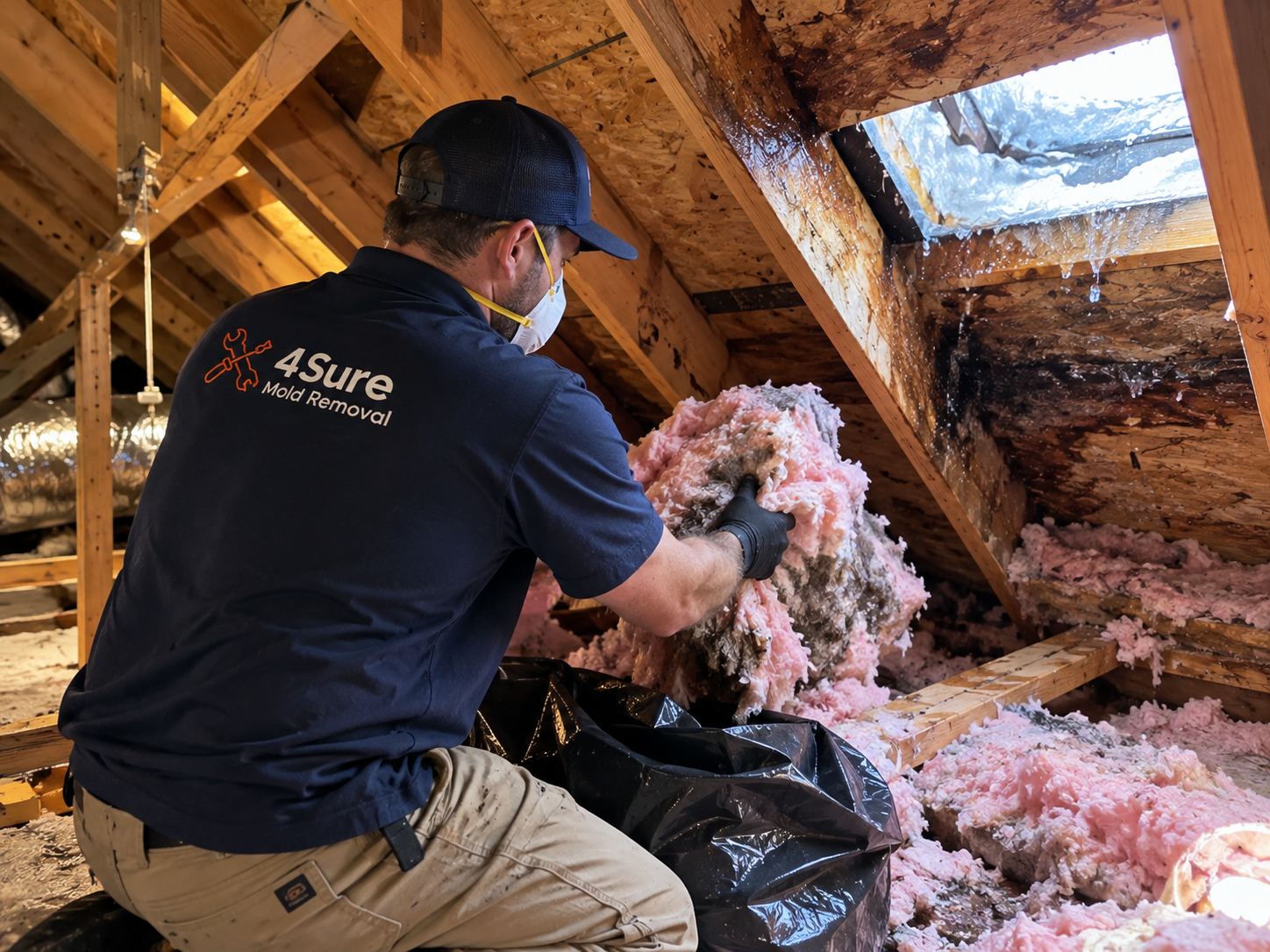
A February cold snap built up an ice dam at the eaves and water worked its way back under the shingles, soaking a bedroom ceiling and the attic insulation above it. We used thermal imaging to map the full wet area, bagged and removed the saturated insulation, dried the ceiling drywall and attic framing to a stable reading, and left the homeowner with a short list of ventilation and insulation improvements that should keep ice dams from forming again.
Reviewed by: Tyler Bennett, Restoration Project Manager · IICRC WRT/ASD #291438 · 4Sure Mold Removal, 1330 S 1400 E, Spanish Fork, UT.
Verify our credentials yourself
- Utah Contractor License#961339-4102 – verify at Utah DOPL
- IICRC Certified Firm#923321-2371 – verify at IICRC Global Locator
- Liability + workers’ compCarrier: The Hartford – GL $1M/$2M, WC EL $1M/$1M/$1M
- BondedYes – Utah-licensed, bonded and insured LLC
Written warranty on every job
Transferable once to a new homeowner within 24 months with a signed transfer. Read the full warranty terms →
A recent job in Canyon Hills
February 2026: An ice dam pushed meltwater into an upstairs ceiling and the attic insulation along Canyon Road near Powerhouse.
With roof and attic leaks, we trace the water from the entry point down, pull wet insulation, check framing and ceiling drywall with meters and a thermal camera, and dry the attic and rooms below before repairs.
Related: how ice dams cause roof leaks. Back to our Spanish Fork water damage team, or see 24/7 emergency water damage help.